Old Tunes on Spruce is from the collection Mouth Quill—Poems with Ancestral Roots. The video version includes my reading of it. A PDF of the text is available below.
Estonian Terms: Kannel – a zither, first played by the God of Music and Poetry; Kukukuu and pillilil – bird chatter in Estonian runic song verses
SomeReflections about Old Tunes on Spruce
The “lap harp made of spruce” in this poem refers to a kannel. This is a beloved instrument, embedded in Estonian mythology, and is the instrument played by Vanemuine, the God of Music. Soundboards of this instrument have often been made of spruce.
I describe plucked tones clustering and rising. From the perspective of acoustics, when a string is plucked freely and reverberates it plays not only the fundamental tone, but also overtones are created, and they mingle and rise into the air. These clusters are sometimes harmonious and sometimes discordant—here, they symbolize the disparate experiences that came to me from the archaic songs: the beauty (beautiful melodies and sounds, scales, rhythms) but then, later, the realization of historical horrors (like the cattle trains that many, including in my own family, were piled and that led to Siberian suffering or death.)
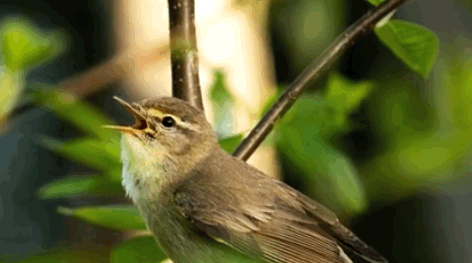
Runic songs are filled with the onomatopoeia of bird sounds
Later, I came to realize that the songs and sounds are not just my own, but an ancestral soundscape. The bird chatter Kukukuu, pillilill, vaak vaak vaa comes from a runic song Lind Lohutab (The Bird’s Consoling) and Iki Iki Mina Vaene. I have enjoyed singing this song with its many verses and variations, depending on the originating parish and singer.
As a writer, where to begin in trying to understand an original source song like this? Being fluent in Estonian, many words were familiar to me, but many were not, and not to my contemporaries either. Searching for the meaning of the word Iki, I wrote to the Estonian Language Institute, which also led me to dictionaries that contain dialects and archaic language. They explained that Iki here is in a dialect and means “to cry.”
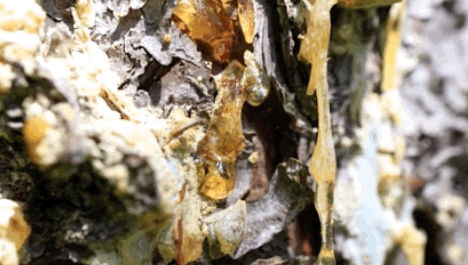
Sap forming from a tree
My poem ends with sap forming, a process that occurs when wood is injured, bringing to mind historical injuries, the wounds of our people. Here, sap is symbolic as a vessel containing both pain and beauty .
Thank you to The Northeast Coast (Issue 2, Winter 2026) for publishing my poem describing the lovely harmony between my husband’s pursuit of theoretical scientific ideas in nature and my simultaneous exploration of the natural setting in the beautiful seaside town of Point Cape May, New Jersey.
This a slightly modified version of an essay by Kaja Weeks published originally as A Lifelong Passion for Estonian Jaanipäev in Feasts, Fairs and Fiestas: Celebrations from Corners of the World, Christina Hoag, Editor. Red Penguin Books (2024)
I grew up far from Estonia, a little northern country on the Baltic Sea that was my parents’ homeland. Yet from early childhood, celebrations from its ancient roots planted themselves within me.
Midsummer became inspirational! Two days—bridged by a night (June 23-24) when dusk is said to kiss dawn—form a magical holiday, Jaanipäev. As the first American-born child of World War Two refugees from Estonia, I absorbed its language even while growing up in suburban north New Jersey. The festivities of Jaaniöö (Midsummer’s Eve) and Jaanipäev (Midsummer’s Day) began with bits and pieces of childhood enchantment and grew to a life-long fascination.
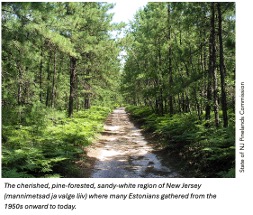
Celebrating in the Jersey Pinelands—far from Estonia
As I write this, many communities where I live in North America will be planning their festivities to celebrate Jaanipäev. Seattle, Portland, Alberta-Canada, Lakewood, Middle Village Long Island, Connecticut, and many more will celebrate.
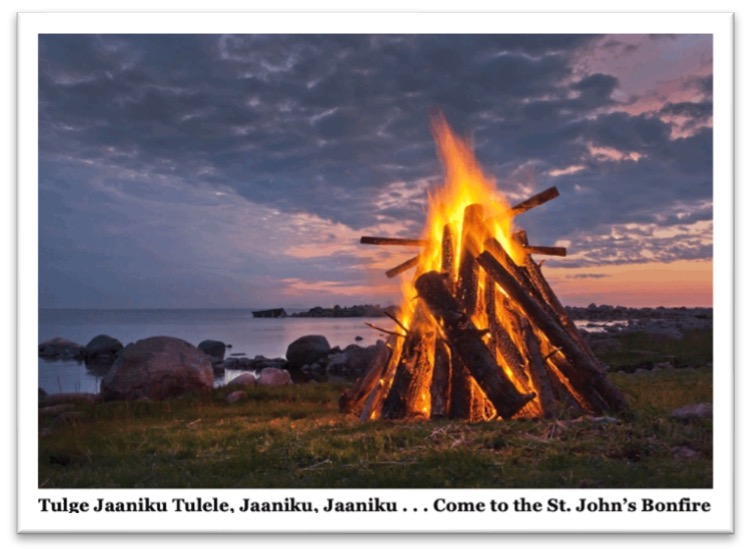
But decades ago in an Estonian communal space of pine-forested south Jersey many customs were first kept alive, including the magnificent bonfire of Midsummer’s Eve by the folks who had just a few years earlier arrived as refugees. I was just a slip of a girl when I first became riveted by bright, flaming tongues reaching up to the darkening sky, pops sounding and sparks lighting the air. The deeper meaning was not yet clear, only that it was connected to ways of beauty and yearning that came from my family’s homeland.
At that time, with the refugee community just beginning to settle into the new world while still holding strong ties to each other and their birthland, well over a hundred people would show up. Generations mingled, from infants to grandparents, and most everyone knew (or knew of) each other.
The evening was preceded by an afternoon of camaraderie around shared foods, drink, and most importantly, indulging in long saunas. The preeminence of sauna-going as part of Jaanipäev has been present from age-old customs. While back in the home country saunas abounded and were a natural part of weekly or even daily life, they also held an important place in our North American gathering spaces. Estonians simply love saunas, sitting naked or wrapped in a towel in the hot steam with good company, using birch branches with their leaves intact for an invigorating massage. The unique sound of birch branches whisking the skin and its associated fragrance is treasured in our sauna-culture. Warming up in the heat is alternated with a cold shower (even better, in some locations, is a dip in an adjacent lake) or sitting in a cozy front room where there are cold drinks and snacks. Then back to the steamy heat!
Meanwhile, early in the day big logs were dragged from the surrounding woods to a central site for the much-anticipated evening event. Kids were encouraged to find plenty of dry branches, brush or paper scraps for kindling. Then a sturdy foundation and top logs that would fuel a long-lasting fire was created. I loved watching the artful construction, followed by the crowd’s first chants of Sütti, sütti—light up, light up—until yellow and red fire blazed high and the scent of wood smoke filled the air.
Around the bonfire songs sounded well past midnight. I sang too, in a language different than my school-day English. These words were filled with lilting vowels, laced like pearls between flickering consonants—Jaan läeb Jaanitulele, kaasike—Jaan goes to the St. John’s bonfire, kaasike. The verses painted pictures of a young man and his silk-tasseled, silver-beaded horse, pulling a brass carriage with gold coins glinting in its wheels. Next to Jaan sat a rosy-cheeked maid, his beloved.
Elders told stories of Jaaniöö, how in the old country this was the time of the midnight sun, an orb that blushed until vanishing for a moment just before new light began. The long days left no room for night, only a dreamy twilight settled over the ground. They whispered about the sõnajala õis, a blossoming fern in the forest that would bring luck to those who found it. It would be some years until I grasped the inherent love spells of young couples, whose midnight forays in their search for a glow could only be magical since botanically ferns don’t blossom. But the luminous, woodland image stayed in my child’s eye, reappearing decades later as poetic metaphor in my writing.
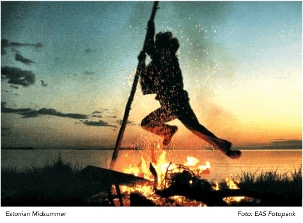
Sometimes, as the fire grew lower, one or another brave soul would leap over it. This ritual, I would learn later, was one of many rooted in pre-Christian times and was meant to bring good luck. In earlier times when Jaanipäev was known by other names (such as Põõripäev, Turning Day, which reinforced the significance of seasonal change), countless customs with other-worldly connotations prevailed. Once the Christian calendar came into effect the day melded with the nativity of St. John the Baptist, and the appellation of Jaan (John) took hold, hence the English translation to St. John’s Day even though the celebrations in Estonia have not held those religious values. Rather, ancient meanings marking the end of spring sowing and forthcoming work of summer haymaking held strong, with traditions believed to ensure prosperity for the remainder of the year.
At Jaanipäev spirits were asked to bestow luck for livestock and crops. There was a strong belief that the light of the Midsummer fire would protect against evil creatures that might move around in the night, one of the reasons everyone was urged to partake. Particularly before the 19th century, vocalized charms and spells along with many fascinating magical rituals prevailed. Historic accounts give examples such as bathing in morning dew, which was believed to bring beauty, health and luck. Just how did one collect the elusive water droplets? One could simply kneel in the grass and bring dew to the face with moistened hands. Or, in the evening one might take fabric such as a shawl to the meadow and pull it until through until thoroughly wet. Then the precious dew could be squeezed into a bowl or even preserved in a bottle.
Such hints of nature’s primal power still color the holiday. Even if participants no longer fully believe in the ancient magic, some rituals still pay tribute to powers of spirits and nature. The practice of fire-leaping that I witnessed at our bonfire gatherings is a great example. At that moment though, for a youngster sitting cross-legged on a blanket in front of waning flames in the Jersey Pine Barrens, the dares, whoops and cheers merely conveyed a sense of delight embedded in this holiday.
Hard Historical Events Shaded Everything, Even Holidays
Had I been born and raised in Estonia, I might have reveled endlessly in Jaaniöö’s airy allure. But like many things entrenched in history, particularly those passed through family kaleidoscopes of loss and ensuing trauma, darker colors among the summery green were eventually revealed as I grew older. The fact was, our community of parents had fled for their lives from their homeland after two successive invasions and in advance of a third that would brutally take their countrymen, women and children even as they themselves made it to freedom. They longed and grieved and raged. Their will to preserve that endangered culture permeated all our lives so that even celebratory beauty carried undertones of mourning and resolve.
My contemporaries growing up in Estonia certainly were heaped with hardship—the same wartime horror (Soviet occupation, then Nazi, then again Soviet occupation) that cast out my family and eighty thousand others from their native land like seeds into the wind left the occupied homeland behind an iron curtain for nearly fifty years. Grim days were punctuated by massive deportations to Siberia, censorship, and oppression of individual free will. Certain songs, writings and even holidays (such as Christmas) were forbidden and had to be celebrated in secret.
The Midsummer holiday escaped that prohibition. Retrospectively, my impression (and hope) was that for home-Estonians, as we called them, this might have been one holiday during which young and old could take flight to an utterly joyous, bewitching time. I believe our kin drew profound power from the land itself. Estonia has always been infused with polytheistic reverberations in which trees, rivers, and other parts of the earth are alive with spiritual meaning. And consider midsummer’s spectacular interlude of white nights and peak of flowering beauty, how fields with spikes of golden rye rise among blue cornflowers and scarlet poppies, how the woods, roadsides and meadows are filled with myriad wildflowers. On the heels of the solstice, it is a call to harness the brightest time.
Across the ocean our celebrations were contained in half a night and maybe part of a day until we returned to unremarkable towns and cities, distant from each other and filled with workaday English. But in Estonia, by June 23rd,then as now, cities and populated towns emptied as most people simply seemed to disappear from their daily dwellings to natural landscapes throughout the country. Age-old customs prevailed—birch branches gathered to decorate indoors and out, including horses and farm animals, birch whiffs made for all-important sauna going, field flowers braided into wreaths for girls’ hair. In another example of nature leading the way, Jaanipäev feasts have always been laden with dairy foods since early summer’s rich grass yields the best milking time for cows. And while our teens and adults enjoyed celebratory beer during this time, we always also heard of a special fermented alcoholic drink, Mõdu, popular during Midsummer. Made with water, birch juice, honey, local berries, fruits and spices, this traditional beverage was one some of us would only get to experience after Estonia regained its independence (1991) when travel there became easier.
Small Pinewood Bonfires vs An Entire Land Lit with Bonfires
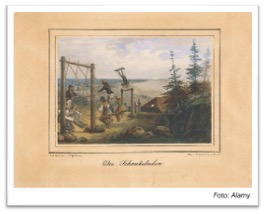
Our North American pinewoods bonfires were wonderful, but subdued in comparison to the effect of those lit throughout an entire land—on Estonian hillsides, farmyards, at the edge of forests, in river bends, or by the sea. On the islands, old boats transformed into festive pyres. Village swings became a center of play and singing. To describe them as “large” dwarfs the reality of these giant wood structures on which two to eight people can stand on opposite planks, grip the upright beams and rhythmically rock toward the sky.
We didn’t have those incredible swings in south Jersey, but with fire crackling in the background we did hear stories about them from people. They were the ones who carried memories from their own childhoods of growing up in a free Estonia, who played ring games and swung on the big swing in a village green or homestead farm.
Thankfully, they also remembered the so-called “swinging songs.” So, in the 1960’s while American pop radio played The Beatles, I Want to Hold your Hand and Simon and Garfunkel harmonized The Sounds of Silence, I was smitten by old dialects and tunes . . . Veli hella vellekene, tee meil kiiku kiitusmail . . . Sweet little brother, make us a swing on the green . . . Kiigu, kiigu kõrgele . . . Swing, swing high.
How the Songs Lit a Life-long Creative Flame
In North America these words and melodies were heard nowhere else at that time besides small clusters of Estonians who were bringing their children into the fold. And it was these very lyric expressions that led to a critical turning point for me. Their presence explains how a child—who experienced an esoteric celebration in a rare language from a faraway place upon whose shores her foot had never stepped—went forward on a life-long path to own the holiday her own way.
I never stopped singing and, in fact, became a professional musician. I continued to love traditional music of Estonia so much that I performed it, studied it and eventually visited a free Estonia to hear more of it. Lyrics filled with descriptive metaphors linked to nature moved me and led to scholarly books and archives that documented history and held extensive field recordings. Some of the most appealing narratives had themes of Jaanipäev. The recollections of songstress Minna Kokk were especially gorgeous as she described how everyone, young and old, was expected at the bonfire. “Dozens of fires at dusk that shone like stars in the sky, so many you couldn’t count them,” she said. She described dancing, swinging on the big wooden village swing, and the romantic search for a magical fern blossom, with an “evening kiss, that on Jaanipäev’s next morning still burned on a maiden’s lips.”
Through folkloric collections I heard song recordings made by musicologists early in the twentieth century. Some of those singers were born in the late 1800’s! One woman, named Marie Sepp, was from Kolga-Jaani parish, a relatively isolated area of farms, meadows, forests and marshes in southern Estonia. Marie was 74 years old in 1937, when her singing about Jaanipäev was recorded. “Come to Jaaniku (the St. John’s bonfire)” she sang, adding, “Come tend the fire, be on guard for the sparks!” How happy I was to learn the catchy melody and sing along, moved that the voice I was hearing was from a woman who had been born around the same time as my own Estonian great-grandmothers.
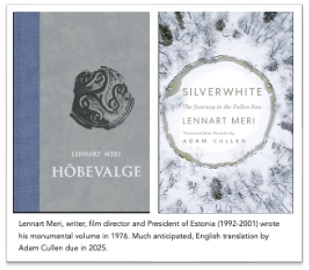
Perhaps the most astonishing revelation through my research came through reading the book Hõbevalge (Silver White) by Lennart Meri, the first president of Estonia after the country regained its independence. He was also a renowned writer and anthropological filmmaker whose reconstructions of history included scrutinizing indigenous poetry. These so-called runic verses were passed from generation to generation by oral traditions and a phenomenal collection is archivally preserved. Meri suggested that what later came to be called Jaanipäev bonfires may have been spurred by the Kaali meteorite which fell upon an Estonian island, Saaremaa, around 4,000 years ago. A cataclysm with the impact energy comparable to the Hiroshima blast, it fell upon a lightly populated area and was also widely witnessed in the skies of the Baltic Sea region. I understood Meri’s suggestion that Jaanipäev traditions may be re-enactments from the ancient fireball’s earth-shattering incident when I saw for myself the event memorialized in archaic verses. “I saw Saaremaa burning,” is among the descriptions, with songs reflecting a belief that the sun itself had fallen to earth. In one of my visits, I stood on the island at the meteor crater site, which survives as a small lake, rock-rimmed, round and full of dark water. I was mesmerized, enveloped by June’s light and by time seeming to stand still. Ancient connections stirred within me.
Flash forward—decades later from my childhood, the year 2021. For the last year and a half, the world had been crippled by a global pandemic. Normal lives, work and travel were halted; unimaginable numbers of people became ill or died. Remaining functional, not to mention creative, was challenging. Fortunately, I’d finished a collection of poems inspired by my ancestral roots and it had been published the year before. One of the poems was titled Midsummer Birches, and these phrases from it—Jaaniöö birch leaves bitter-sweeten the air. A young man’s beloved rides his silk-tufted horse—were broadcast.
This happened as a result of a composer from California, Brigitte Doss-Johnson, who was so inspired by my poem, Midsummer Birches (from the collection Mouth Quill¾Poems with Ancestral Roots), that she set it to choral music. She then created a virtual chamber choir to perform it. To my astonishment, singers in addition to Estonians—from the United States, Canada, Japan, the Basque region of northern Spain, Malaysia, and Australia—learned the complex music and many words in Estonian, one of the most difficult languages.
Doss-Johnson’s music contained my English language poem that was set to her newly composed music that she wove with an old traditional Jaanipäev song. Choristers’ calls to come to the Jaaniöö bonfire were sung complete with claps, shouts and stamps, and alternated with four-part a cappella singing that portrayed Estonian Midsummer through a vibrant and mystical sound palette. The performance, in the form of a musical video, was finished just in time and released globally through cyberspace on June 24th, the day marking Jaanipäev.
With this music I continued to celebrate a holiday beloved since I was a child, passed down from a long line of ancestors, now with my own artistic expression and its sounds ringing out around the world.
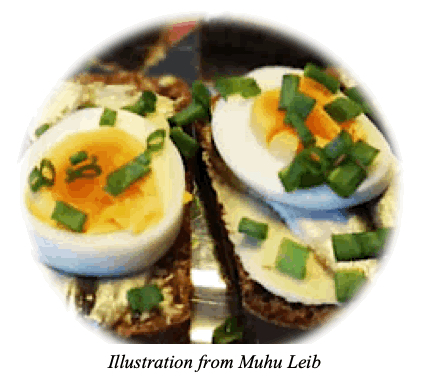
Inspired by the rich grass growing season, Estonian Egg Butter is a perfect dairy spread for Jaanipäev, the Estonian Midsummer celebration.
Ingredients:
3 hard-boiled Eggs
4 T (1/2 stick) of softened sweet butter
1 T Chives, finely chopped
1 T Dill, finely chopped
1 t mustard of choice
Salt and pepper to taste
Method:
Boil eggs 10 minutes, then plunge into ice water. Peel when cooled. Use fork to mash yolks to creamy consistency. Chop egg whites fine or chunky, as preferred. Combine all ingredients. Use a small wooden spoon to lightly whip to airy consistency.
Serve:
Spread generously on squares of black rye bread (Leib).
Optional topping: Thinly sliced cucumbers
****
A PDF copy of the essay can be read or saved from here
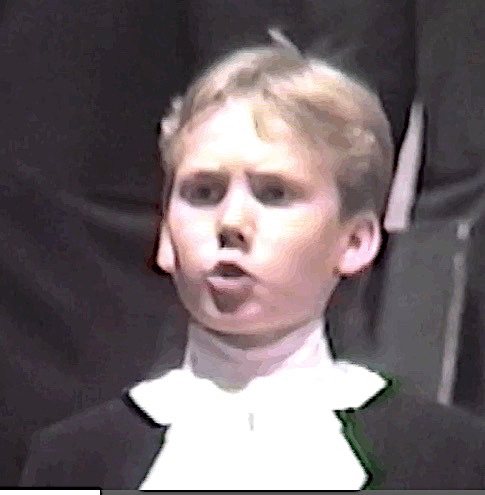
The Estonian version of this article (Meenutades poisse Eestist New Yorgis—Raudse eesriide viimsed päevad) was published by Vaba Eesti Sõna on May 23, 2024. Here are my recollections of a moving and unique concert that took place 36 years ago this June by a superb boys choir from Estonia. At the time, they were the first cultural ensemble to visit the United States from Estonia since World War Two. Estonia was still under Soviet occupation, and among the audience were many of those who had been forced to flee their homeland and had not seen it since.
I attended that concert along with five hundred others including my mother, whose photo from the event was published by this same newspaper at the time and my father, a hardened self-described Estonian patriot whose tears fell while singing along as best he could with the boys’ rendition of America the Beautiful.
I was able to use my own memories of the event, news reports from old newspapers, an archival film of the entire concert by Kalju Meri, and interviews.
A boy chorister from RAM Boys Choir from Estonia singing in Manhattan 1i 1988. Kalju Meri film.
I am grateful to Valnar Neidre, then a twelve year old chorister, and now a grown man in Estonia who warmly shared his memories of the event.
Read in English about the special alchemy of that evening here.
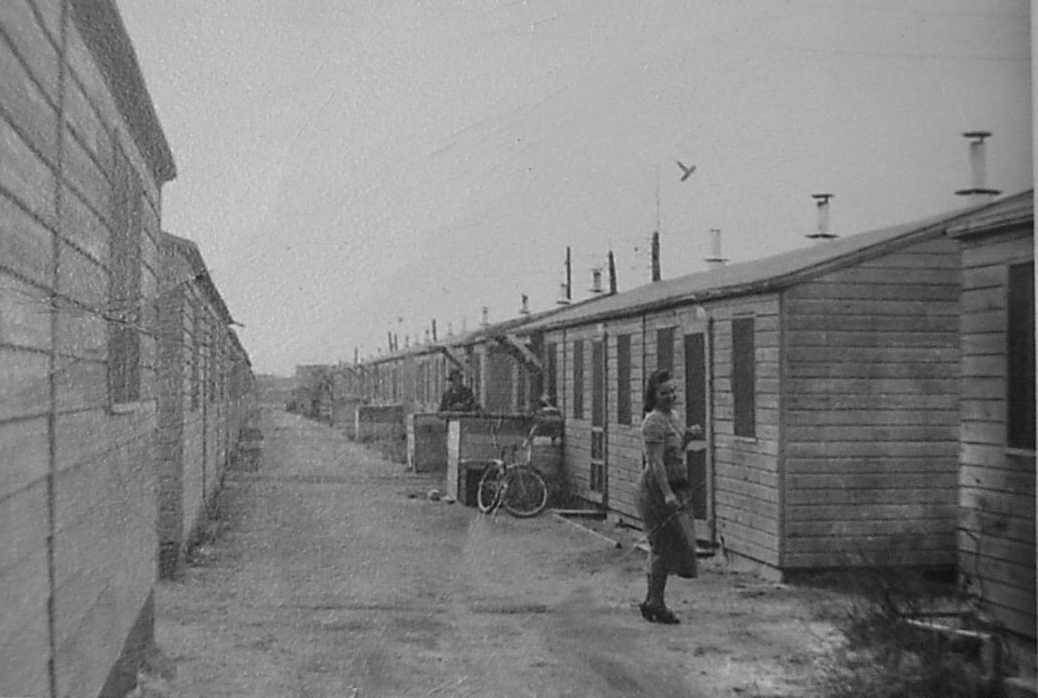
The first place my World War Two refugee family landed in America was a sprawling corporate-run farm that “The Spinach King” had created in rural south New Jersey.
My mother, Salme Parming, at the barracks of Hoover Village in Seabrook Farms, 1949
As displaced persons, they were sponsored for work in this country by Charles Franklin (C. F.) Seabrook. By the time they arrived, Seabrook Farms had become one of the biggest producers of flash-frozen vegetables in the country.
Seabrook Farms held the most extraordinary conglomeration of people. C. F.’s grandson, John, describes it in a 1996 a fascinating New Yorker article, The Spinach King, like this:
Many of the workers at Seabrook Farms were refugees of twentieth-century upheavals and hardships: Italians avoiding their war with Turkey in the nineteen-tens; former soldiers of the White Russian Army in the late teens and early twenties; Americans who lost their jobs during the Depression; Jamaicans and Barbadians and German prisoners of war in the forties; Poles, Hungarians, and Czechs fleeing the advance of the Soviet Army in 1945; Japanese Americans from ’44 to ’47; and Estonians and Latvians running from Stalin’s rule in the late forties and early fifties. My grandfather built “ethnic villages” for the different groups, and this collection of villages became Seabrook. In the nineteen-forties and fifties, there were thirty different languages spoken in Seabrook, a town of about five thousand people.
Although it occurred before my birth, the legacy of Seabrook Farms as my family’s first home deeply infused my psyche. I can still picture the wooden trailer in which they had towed all their belongings when they finally left to strike out on their own. It remained a ghostly fixture in the back yard of our house in North Jersey for decades, until all the boards—paled by rain, sun, wind and time—deteriorated and all that remained was the steel axle and wheels. My mother planted flowers around it.
Seabrook Farms (1949) imagines my mother’s arrival to this place—both the salvation and disbelief—you mumble, home, until it rises like a question. It was published in my book Mouth Quill—Poems with Ancestral Roots.
NEW! Click below on the Audio to hear Kaja Weeks reading of the full poem, Seabrook Farms (1949).
Click below on Download to access the full poem in print.
NEW ANNOUNCEMENT! THE WORLD PREMIERE of the film by Helga Merits (a Dutch-Estonian journalist and documentary filmmaker) The Paradox of Seabrook Farms announced! MARCH 16th 2024 at 11 am at the Levoy Theatre in Millville, NJ. The film includes her extensively researched account of an amazing time and place in American history.
Update for Seabrook Farms (1949) – January 2025
I’m thrilled and proud to announce that Helga Merits has included an illustrated audio version of my poem Seabrook Farms (1949) in Bonus Material for the newly released DVD version of her film The Paradox of Seabrook Farms.
Stunning historic photo and film footage with originally composed music lift the recitation to a new level.
“… those who fled with you from a landscape riven by flames into the stormy Baltic Sea.” Image from Helga Merits’ DVD The Paradox of Seabrook Farms film Bonus footage accompanying Seabrook Farms (1949) poem by Kaja Weeks
An explanation of motivation for writing the poem is included as well:
I wrote the poem Seabrook Farms (1949), first, to imagine my mother’s experience there and to illustrate psychological dissociation as a shocking rift that can arise from displacement, specifically as it relates to our notion of what is Home. After a terrifying flight from her war-torn native land, she arrives in a new land, but how can her mind accept the south Jersey fields of spinach and barracks to be Home, when Home means the free, white beaches of Pärnu in Estonia? That homeland has literally vanished from beneath her feet, and even far away it is no longer free.
Secondly, I wanted to reflect intergenerational transmission of trauma that many of us as children of refugees experienced, as well as the resolve to heal. Unborn, I could not be there for her at the time of this stressful rupture, but I could bear witness later. In the poem I reimagine myself as a persona within her, not giving up—I will cavort inside your stunned mind’s eye until you can wake to yourself.
I’m honored to have had excerpts from The Dolomite Heel Print read by Claudia Green in Seattle at the poetry reading evening of Cirque—A Literary Journal for the North Pacific Rim.
Claudia Green reading The Dolomite Heel Print from Mouth Quill—Poems with Ancestral Roots by Kaja Weeks. At Cirque—A Literary Journal of the North Pacific Rim readings August 12, 2023
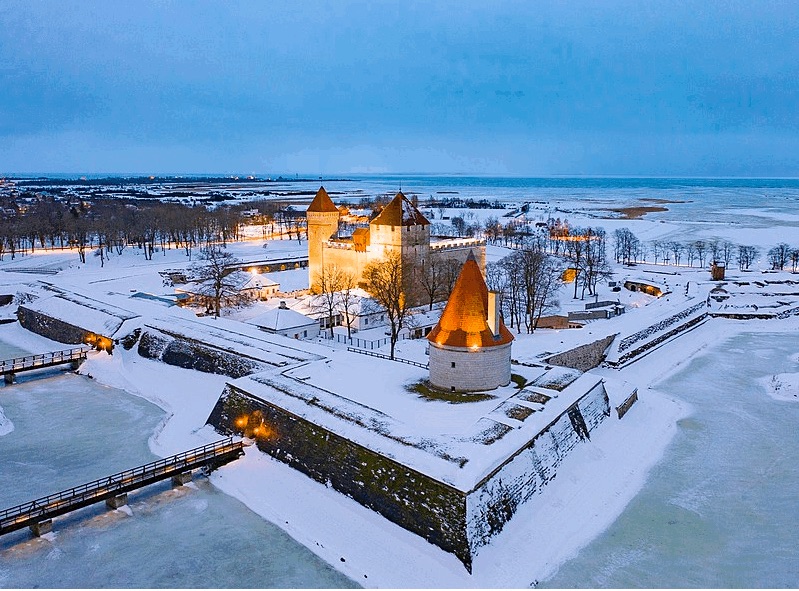
The Dolomite Heel Print is from the collection Mouth Quill—Poems with Ancestral Roots(Poetry Box, Portland 2020). Its seven sections focus on the island of Saaremaa, Estonia—its natural beauty, horrifying events of World War Two, and their intersection with my life as a young person during the Cold War and much later, the mystery revealed during a visit to the island’s Kuressaare Castle.
Below is a view of Kuressaare Castle, seen with its towers, bastions and the sea behind it (Stefan Hiienurm, Wikipedia, Common License.)
At the center of The Dolomite Heel Print poem is reference to an extraordinary song, Öö Pime (Dark Night) that came to us, children of Estonian refugees, nearly secretly during the Cold War. It was smuggled back to the west by a young relative of some homeland Estonians at a time when those in Estonia, still occupied by Communist Russia, could have suffered greatly had they been exposed. We sang the song amongst ourselves with great reverence, often with teary eyes as it spoke of departure from the ravaged homeland and vows to return one day.
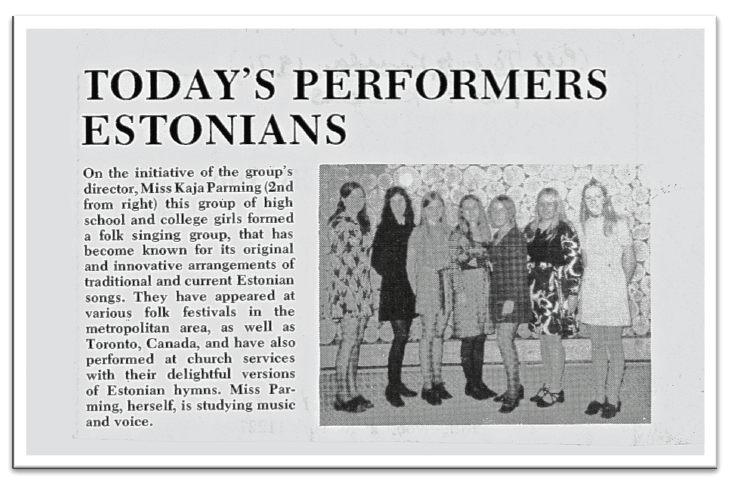
Among those singing Öö Pime was Ensemble Kannel, a singing youth group of traditional Estonian music (Ursula Brady, Angela Dupin, Anneliis Elmend, Tina Karm, Tiiu Messner, Kaja Parming [Founder/Director], Anne Pleer, Kaie Põhi.) . According to newspaper accounts, one of our first public performances of the song was in 1970, but there is an even more historic recording from 1975. It is Ensemble Kannel singing at an important formal event in New York City, a commemoration of Estonian Independence. These were somber yet steadfast annual events, as Estonia was still occupied and regaining of freedom seemed like a dream (which was achieved in 1991). Toward the end of this recording, the audience can be heard spontaneously joining in, showing the widespread impact of the song by this point.
One historic reference in the song was to Estonian martyrs spilling blood round dolomite heel prints (lubjavildi kand), something we could not possibly have fully comprehended the meaning of as teenagers growing up in North America. That mystery was revealed to me decades later when I visited a free Estonia and met the dolomite craftsman of Kuressaare Castle. All these events (and research) eventually coalesced into the poem, The Dolomite Heel Print.
Author Deirdre Callanan, in her praise for poem, writes “Rich with birds and melody, these pages sing, but her incredible “The Dolomite Heel Print” makes sure we understand not all songs are merry. Mouth Quill, a dark crystal studded with light, amazes.“
And author Hala Alyan says, “The Dolomite Heel Print, in particular, is a breathtaking exploration of history and life and identity … a stunning piece! “
In memory of Kati Saksniit Walters (1951-2022), the poem memorializes an event when she, my Estonian friend from childhood, and I, and our American friend Marie slipped off into Manhattan in the late 1960s. An innocent time in so many ways compared to much that was to come, catching that magic time that carries us from childhood to early adulthood.
I find the role of first languages and how they continue to unfold in our lives to be fascinating. “The milk language” (Ghita El Khayat) is a beautiful metaphor for the way earliest sounds, rhymes and lullabies are conveyed from mother to infant and continues its influence long after.
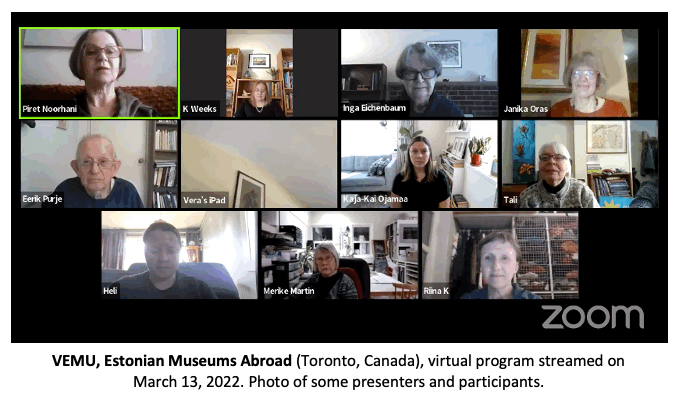
I felt very grateful to have been invited to share poetry from my collection Mouth Quill—Poems with Ancestral Roots—at VEMU, Museum of Estonians Abroad celebration of Estonian Mother Language Day (Emakeelepäev).
This day is a national holiday in Estonia, and a beautiful way to preserve and cherish the Estonian language.
The virtual event included wonderful presenters. Janika Oras, Senior Folklore Scholar of The Estonian Literary Museum gave a fascinating overview of regilaulud, Estonia’s ancient oral song and verse tradition, and talked about how their influence—especially maternal qualities and the presence of multiple realities—permeated poetry in the Mouth Quill collection.
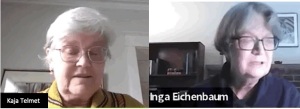
Kaja Telmet and Inga Eichenbaum, of Toronto, each recited a poem from the collection and Kaja Telmet talked about her emotional connection and understanding of the collection from the perspective of one whose family, like mine, were World War II refugees from Estonia.
Triinu Villukas and Madli Oras, two young Estonians and singers currently living in Vienna, Austria, led everyone in regilaulu singing, including the song which inspired content in my poem, Mouth Quill. Piret Noorhani, VEMU’s chief archivist put together a wonderful, rich program and moderated throughout.
You can read an English translation of my remarks here.
The Estonian Philharmonic Chamber Choir performed Veljo Tormis “Forgotten Peoples” music in Berkeley, California, 1990
Thousands of years after Baltic-Finnic peoples settled on and near the shores of the Baltic Sea, Veljo Tormis composed a song cycle, Forgotten Peoples, people on the verge of extinction and whose languages are spoken by a handful of people—Livonians, Votes, Izhorians, Ingrians, Vepsians and Karelians.
I loved writing the piece Estonian Music Week Sparks Reflections of Forgotten Peoples. It memorializes the first time I heard this magnificent music, which was thirty years ago in Berkeley, California, during The Estonian Philharmonic Chamber Choir’s debut USA tour, with Tõnu Kaljuste conducting. I’m so pleased the article about my memories and its continued significance was published by the weekly newspaper, Eesti Elu, in December 2021 (Issue 50, p26.)
My writing was partly inspired by a recent VEMU (Toronto-based Museum of Estonians Abroad) virtual program led by VEMU’s chief archivist, Piret Noorhani, that featured a spectacular documentary by Collegium Musicale and their 3-year quest to sing the Tormis songs while visiting the people portrayed in Tormis’ music. Serendipitously, at about the same time as I saw Collegium Musicale’s documentary, I came across a home video which turned out to have a twenty minute excerpt of the concert I attended thirty years ago! From research, including tracking down the original US Tour agent for the concert, I realized that this concert tour was in all likelihood the first time Tormis’ masterpiece was performed in the United States.
I have since been able to make a digitized copy available to historic and musical organizations in North American and Estonia. I have also created a shorter (approx. 6.5 min) annotated version for you to enjoy.
Excerpt of The Estonian Philharmonic Chamber Choir’s 1990 performance of Veljo Tormis’ “Forgotten People” song cycle in Berkeley, California
“Midsummer Birches,” a poem from my collection Mouth Quill—Poems with Ancestral Roots went live on June 24, 2021 as a choral pieces composed by Brigitte Doss-Johnson and sung by the virtual choir, Laulusild. A traditional old Estonian tune and words were woven with newly composed music set to my poetry. One piece is a celebration of Estonian Jaaniöö (Midsummer’s Eve) and Jaanipäev (Midsummer’s Day).
The English language poem begins by invoking Estonian traditions, referencing age-old verses and songs about this most important holiday: Jaaniööbirch leaves bitter-sweeten the air. A young man’s beloved rides his silk-tufted horse. Kaasike, kaasike, the refrain sounds. Trot with pride, mane bedecked with bangles.
The second poem and song is “The Rise,” which includes a recollection of my mother’s lullaby, an old Estonian song (Uni Tule), which I recall hearing as a very young child in America and realized later would have been sung by my grandmother in Estonia, who I never met. This motif is woven into newly composed music of the poem text . . . sleep mists its way from coastal stones crosses a thousand miles, fall upon my eye.
Singers include individuals from North America, Japan, the Basque region of northern Spain, Malaysia, and Estonians from the U.S., Canada, and Australia.
The composer Brigitte Doss-Johnson has used the text from my poem The Rise (from the collection Mouth Quill—Poems with Ancestral Roots) to create an cappella choral composition. The old runic song that was an inspiration for the poem is masterfully woven into an SATB setting. Fragments of the old runic song, Uni TuleLapse Silma Peale (Sleep, Come on the Child’s Eye), survived as early memories of my mother’s lullaby singing, which she would have learned from her own mother, born on the coast of Estonia in the 19th century. The Rise, along with the song Midsummer (from the poem Midsummer Birches) will be performed by a virtual choir.
An exciting new creative project has grown from from my collection Mouthquill—Poems with Ancestral Roots. Brigitte Doss-Johnson, composer and choral conductor, has set two poems to music. The compositions will be performed by a virtual choir.
I am honored that Mouth Quill, the title poem from my chapbook, Mouth Quill—Poems with Ancestral Roots, has been nominated by The Poetry Box for a Pushcart Prize, an American literary prize.
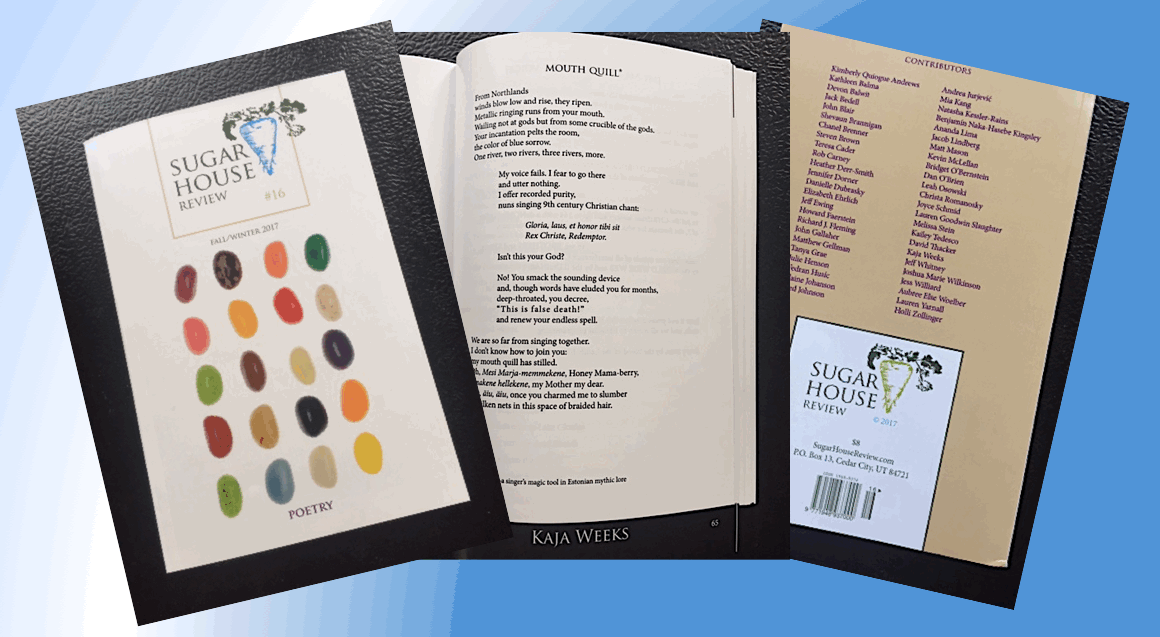
The poem Mouth Quill was first published in a slightly revised version by the literary journal, Sugar House Review in 2017. To read about the original publication and hear a recording, click here.
The Poetry Box, publisher of my book, will host its monthly live Zoom Poetry Reading on Saturday, October 10, 2020, 4 PM Pacific, 7 PM Eastern. I look forward to joining readings of two other poets, Christopher Bogart and Joan Colby (read by Wendy Colby).
Please join me to hear Ancestral Journey—Beneath Ice Sheets, Old Tunes on Spruce, Seabrook Farms (1949), The Songstress and more.
The Poetry Box, a small independent publisher in Portland, Oregon, has done a beautiful job with my debut chapbook of poetry, ready now for pre-order here from my page on
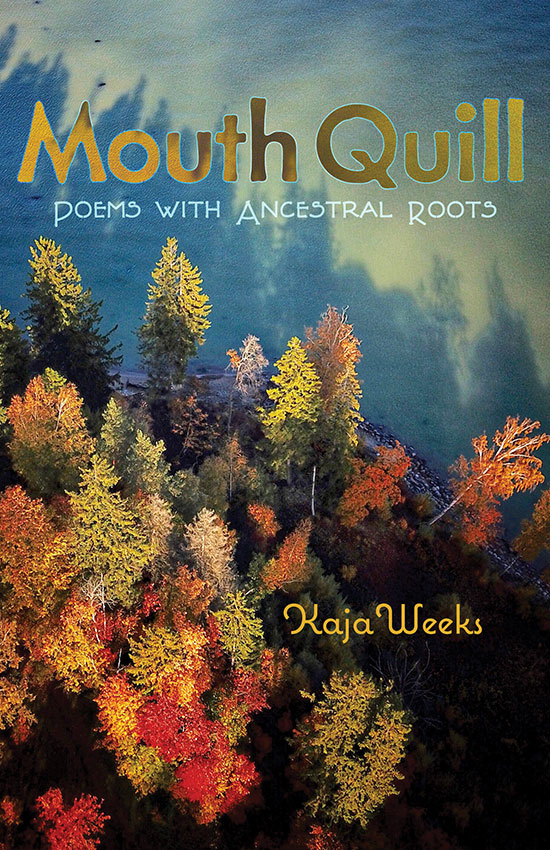
Mouth Quill: Poems with Ancestral Roots book cover, published by The Poetry Box
their website. Please visit to see a description and early reviews.
. . . a haunting intertwining of world history and family history. ~ April Ossmann
The cover is a stunning photo of Estonian forest and sea by Michael Huang. I am so grateful for his gift to me for this collection.
The print edition is slated for September 30, 2020. At that point, you can also order the book from Amazon or from your favorite bookstores.
The term “mouth quill” (suude sulg) comes from ancient Estonian runic song and is seen as a singer’s magical tool. In a lovely verse known as The Village Tells Me, the singer says she has left home enchanting charms—her mouth quill and her tongue click—(keeleklõks). She bids her brothers to ride home with silver beaded horses to bring them to her so she can sing like birds.
When I was a young student, just starting college, I traveled to Finland to study and listen to rich Estonian field recordings of such music. In these last years, I feel so lucky to have been able to access notated music and even listen to oral history recordings on amazing online runic songs databases in Estonia. As I explored an arc of identity, many of these old songs inspired imagery and language in my poems, as did nature and historic events, both distant and more recent.
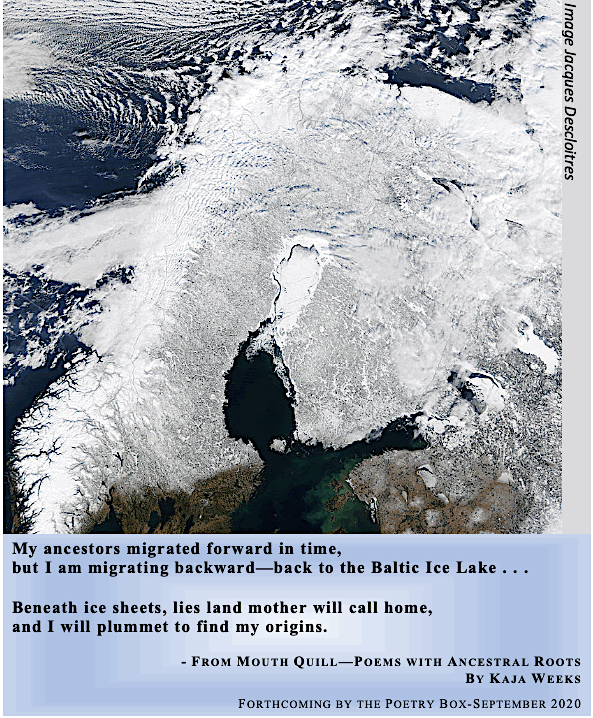
My chapbook of poetry is being published by The Poetry Box and is slated for release in September 2020! The lines below the photo are from the first poem, Ancestral Journey—Beneath Ice Sheets, which begins an imaginary exploration leading to the shores of Estonia. This poem is part of a trilogy, three poems that form the start, middle and end of the collection; the other two being Ancestral Journey—The Milky Way and Ancestral Journey—Helix.
I chose the satellite photo above to share this announcement as it so beautifully illustrates, by way of a (modern) snow line, the approximate glacier lines from 10,000 years ago! You can see Norway, Sweden, Finland, Estonia and even the small island of Saaremaa in this aerial image. Long ago, glacial ice covered all. When the melting began, I imagine the long journey of our Finnic ancestors, leaving the Urals:
Some will be left in river-bends, some follow the reindeer north.
Some will look heavenward at traces of bird-flight, some walk a milky star-path westward.
The term Mouth Quill (collection title and title of an individual poem) is found in runo verse (regilaul)—the word translates to suudesulg and refers to “a singer’s magical tool.” Some of the 21 poems are inspired by themes found in ancient runo verses (with the original runo verses listed in Notes), others by Estonian music, language and historic events. My writing weaves those world views into a life born and lived in America, with deep ancestral roots.
Poet Deirdre Callanan describes Mouth Quill—Poems with Ancestral Roots as “a dark crystal studded with light.”
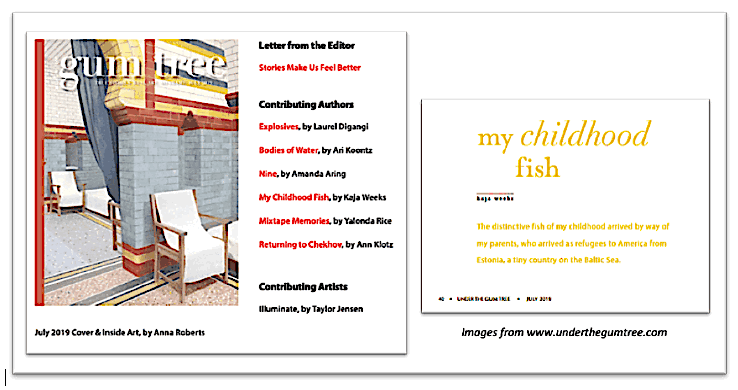
Published as “My Childhood Fish” in Under the Gum Tree . . . July 2019
Under the Gum Tree is a quarterly literary arts magazine that publishes creative nonfiction and visual art. I am so pleased that my writing found a home in their fine publication. You can order print or digital copies from their website.
This is a personal essay with reminiscences from an Estonian-American childhood lived during the Cold War, and how anchovy (or, preferably, marinated sprat) open-faced sandwiches came to carry unique significance . . .
Symbols of ethnic pride and resolve, these little fish sandwiches were traditionally curated and ubiquitous especially after ceremonies remembering Estonian independence . . . in the rooms of the Estonian Civic Club on Manhattan’s East 34thStreet, elder-ladies unfailingly set tables with white tablecloths, flowers, percolated coffee—hot, dark and strong—and always platters of these little fish sandwiches.
And how a refugee-mother’s own longing for a childhood fish (the Räim, a kind of Baltic herring) eventually became a mirror for her daughter’s personal longing . . .
My mother’s perch was lovingly made, the just-warm, salted, golden fillets arranged on a plate with twisted slices of lemon and fresh parsley sprigs.
***
Special Thanks to the IOTA Conference Online Course (2017), taught by American essayist, Sarah Einstein, for inspiring and leavening my creativity, leading to publication of both “My Childhood Fish” as well as the essay, “First Home.”
First Home by Kaja Weeks is an essay published by The Sandy River Review (University of Maine, Farmington) on its website in October 2018.
The piece reflects not only aspects of my own first home, but also of my childhood friend’s home “around the corner,” and each of my parents’ first homes in Estonia (from which they fled during its occupation in World War II)—including my mother’s home located near the historic childhood home of renowned Estonian poet, Lydia Koidula. Koidula was the author of the poignant poem, Meil Aiaäärne Tänavas—The Road Bordering our Yard, which is referenced in the essay.
Cold Spin by Kaja Weeks is a poem first published by The Sandy River Review online site in October 2018. The Sandy River Review is a literary journal of The University of Maine, Farmington.
Cold Spin recalls events that took place on a winter pond, separated from the banks of the Hackensack River by a thin meadowlands ridge. The time period was the early 1960s.
Song-Mother’s voices,
sounds of ancestors once slipped from tongue to air—
ribbon-like, still unfurling.
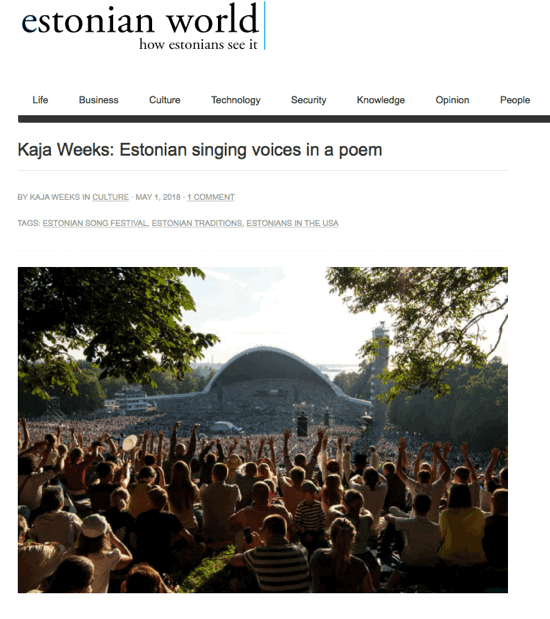
On the edge of the sea
a silver shell holds thousands, singers who face
thousands more on a grassy gentle rise. All inhale.
Though the hour nears midnight
sun skims waters of the Baltic Sea,
flames in the tower-torch leap high.
The singing will not stop, Lee— lee— lo, the sounds form Leelo! Each ancient syllable earned with sweat and love.
A conductor, peering from within a laurel wreath
clasps his chest, lowers his head,
bows to the choir who has honored song.
The watchers become the singers,
the standing levitate,
the air is alive.
Swirling round, melodies rustle, loosen hair,
saying: we are a living sound—sing us speak us hear us.
Song-Mother’s voices—Hääli imedänne!
* Hääli imedänne – Means “magical voices” in old Estonian * Leelo – The old Estonian word meaning “song,” and the title of an actual song
Author’s Note: Voices is a poem from a chapbook manuscript (in progress) in which writings reflect both the trauma and beauty of Estonian culture and history as it rooted in my personal journey and identity.
Songs from my ancestral heritage have been a central part of my life. As a young child I was mesmerized by very old runic songs, called regilaulud—including shepherd’s calls (helletused). These came to me by way of the songstress Ellen Parve Valdsaar, an Estonian refugee whose magical interpretations left a lasting impression upon me. I also heard and sang much choral music, mostly in the a cappella tradition that allows voices to meld within wonderful, enlivening resonance. The poem, Voices, celebrates the height of such a continued tradition, the Estonian Song Festival, first begun in 1869. It is now held in Tallinn every five years and is designated a UNESCO “Masterpiece of the Oral and Intangible Heritage of Humanity.” Click here to hear a refrain from the song, “Leelo” (the old word for “song”) as sung at the 2014 Estonian Song Festival in Tallinn. (In “Leelo” composed by Mart Saar with text from traditional folkverse, the singers plead, “What are these reins, these ropes that bind us?” The antidote, they answer, is “Song! Song! Song!”)
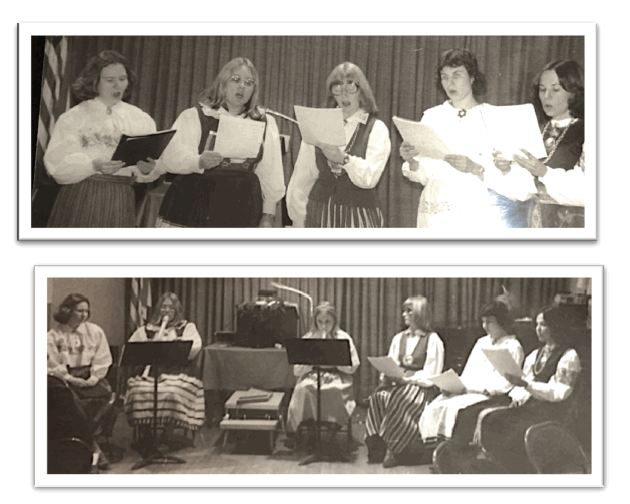
Even as the child of Estonian refugees to America, I understood the transcendent qualities of this music rooted in antiquity. In the 1970’s, as a college music student, I created a small vocal ensemble named Kannel (Zither) which performed mostly traditional Estonian music. Today, I sing with the Baltimore-Washington Estonian Singers (BWES), including in our performance for the capital area’s 100th Anniversary of the Republic of Estonia.
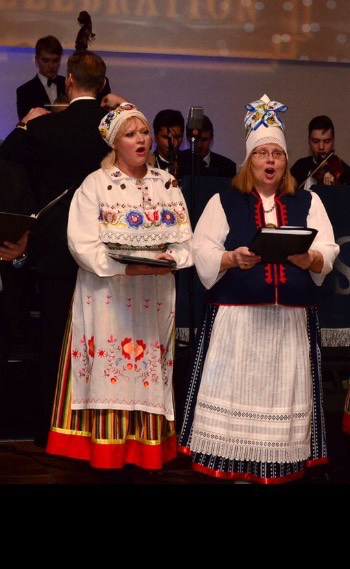
Ira Reiman and Kaja Weeks in traditional Estonian folk costumes, singing as members of BWES at Washington DC- Celebration of 100th Year of Republic of Estonia. February 2018
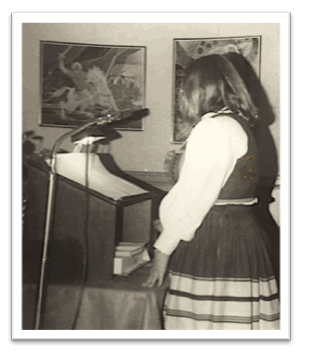
Kaja Parming delivering lecture about old Estonian folk music, New York, 1977.
Ensemble Kannel performing in an evening of Lecture and Old Estonian Folk Songs. (Pictured in lower photo, left to right) Ursula Brady; Kaja Parming (Founder/Director); Talvi Laev; Tiia Papp; Angela Dupin; Kersti Tannberg. New York, 1977.
Kannel in Toronto, 1971 (Pictured from Left to Right) Tina Karm; Angela Dupin; Anneliis Elmend; Ursula Brady; Kaie Põhi; Kaja Parming (Founder/Director); Anne Pleer.
A version of the poem “Mouth Quill” by Kaja Weeks was first published in the literary journal Sugar House Review, Fall/Winter 2017.
Mouth Quill*
At home my stroke-assaulted mother
you startle and confound me.
On my childhood bed
we eye each other.
Metallic ringing runs from your mouth.
Wailing not at gods
but from some crucible of the gods.
From those Northlands
winds blow low and rise, they ripen.
Your incantation pelts the room,
the color of blue sorrow.
One river, two rivers, three rivers, more.
My voice fails. I fear to go there
and utter nothing.
I offer recorded purity,
nuns singing 9th century Christian chant:
Gloria, laus, et honor tibi sit Rex Christe, Redemptor.
Isn’t this your God?
No! You smack the sounding device
and, though words have eluded you for months,
deep-throated, you decree,
“This is false death!”
and renew your endless spell.
We are so far from singing together.
I don’t know how to join you:
my mouth quill has stilled.
Oh, Mesi Marja-memmekene, Honey Mama-berry, Emakene hellekene, my Mother my dear. Äiu, äiu,äiu, once you charmed me to slumber
on silken nets in this space of braided hair.
* Mouth quill – “Suude sulg,” is a singer’s magic tool, and is found in Estonian mythic lore and runic verses
The poem Mouth Quill by Kaja Weeks was reviewed on New Pages as part of its coverage of The Sugar House Review issue in which it appeared. Mouth Quill was cited as succeeding in being “concentrated language striving to be music,” and with the description, “Carefully placed alliteration, assonance, and other literary devices create a fascinating and aurally pleasing poem.”
Author’s Note: Mouth Quill is a poem from a chapbook manuscript (in progress) in which writings reflect both the trauma and beauty of Estonian culture and history as it rooted in my personal journey and identity.
One afternoon when I was five a taxi stopped in front of our small northern New Jersey house. A plump woman in a purple-red flowery dress pushed herself out. Thick stocking seams on her calves ran above sturdy black shoes. With a bulging purse and small suitcase she crossed stepping stones through a grassy yard right to the brick steps upon which I was sitting, just taking in summer. “You must be the little songbird,” she said. Not withstanding that she spoke in Estonian, something no one in the neighborhood besides our family spoke, I bolted inside and alerted my mother that a võõras naine (a stranger woman) was at our house.
Tädi (Aunt) Meeta had come to visit and, as far as I knew, I was meeting our one living relative. Whether the others were dead or not spoken of was a condition I was too young to understand. Tädi Meeta was my father’s sister and, being fifteen years his senior, the only one who was able to risk no peril when she told him, a volatile man, to “pipe down.” I liked her and was surprised to learn that she had a family back in Lake-in-the Hills, Illinois – so we had a little clump of living relatives, after all.
As I grew out of early childhood another relative took on life. She had always been present in our living room – a woman with serious gaze held in a small, lone photo frame. At some point I understood that she was my mother’s mother. And that she was alive. Somewhere — we couldn’t get there, nor she to us.
Miili was my grandmother, but even in absentia I didn’t have that relationship with her. Whenever my sister and I spoke of her out loud we used the term “your mother”—foremost, she was our mother’s missing mother. A hole existed. Something awful had happened that had swallowed up her mother and anything beyond the portrait was simply conveyed by silent watery eyes. Asking more hovered on forbidden, dangerous. She was in a place called Eesti (Estonia), from where my brothers and parents had fled from during war, and I knew what that was from an amalgam of stories, screams and shouts, lectures, ceremonies, songs and photos. Mostly, mother’s-mother was described as “left behind”; but then sometimes she had “stayed behind” because “she was waiting for Sass to come back.” Who was Sass? Why was it a mystery? Another void with centripetal force into which significant people had vanished.
Though I continued using the appellation “your mother,” I had also privately begun to claim Miili as my grandmother as soon as I understood that, rightfully, she was. I recreated her from the flimsiest Known, retrieved her with magical thinking. Like my mother and me, my grandmother had green eyes, and at eight I secretly determined that fact alone made us a trio of soul mates. But actual communication was sparse and letters from behind the Iron Curtain never came directly to our home. They were sent surreptitiously — routed to a place in New York City under a code name. One day a thin, onion skin air-mail envelope properly addressed to my mother arrived from Estonia to our front mailbox. She sat with the letter in her lap for a long time and quietly wept. Her mother, who twenty years earlier had, for “just a little while,” sent off her daughter from Pärnu pier amidst bombs and a burning coastline, who had said, “You go — I’ll wait for Sass,” had died. She never saw her daughter again. Sass never came back.
Short for Aleksander, Sass was my mother’s brother. Gradually my mother opened up about him and others. Their youth in the beautiful seaside town, Pärnu, had been cherished and I hungered for stories; listened, asked questions, wrote into notebooks. It was as if I was plucking her family one by one from where they had been sucked, a dark vortex that had pulled everything under– mother, brother, aunts, cousins and schoolmates never to be touched again; cobblestone streets and tall converging Linden boughs in a town of allées, white beaches – land she loved — never to be seen. Instead, the terror from cattle-cars of people roaring toward deadly Gulags brandished the air.
Sass was snatched midsummer, 1941, when Soviet Russian soldiers took 10,000 people — in one night. Even into old age my mother was never able to shake a trance-like state over it. When, unable any longer to bear the image of my uncle’s remains for eternity under boundless, unidentified Siberian north, I finally asked straight-out, “Where was he taken?” she could only whisper, “I don’t know – somewhere far away in Russia.” “I’m going to find out,” I promised and, unbelievably, I did.
***
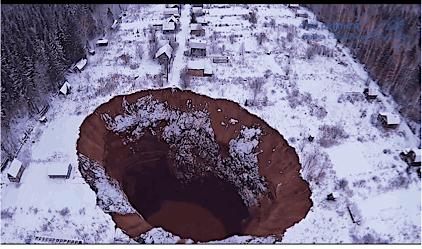
It’s 2016. My mother, too, is gone. With an Estonian film crew I am being interviewed by Williams College students for their class, “Documenting Stories of Escape and Survival.” I am to tell of the effects of Totalitarian regimes, of being American-born to my war refugee parents. One hour has stretched to two. I’ve already sung ancient bird-like melodies and wept through the “Singing Revolution” that helped restore Estonia’s independence after fifty years, squirmed over questions on my odd “double life.” Now I’m sweating. My head feels crushed by chaotic, dissonant sounds – souls crying, shrieking. My finger rests on an aerial photo that, to my utter astonishment, I uncovered from Russian news days earlier. It is a massive sinkhole. Unearthly, its copper-colored sloping pit with a black center presently grows over a buried salt mine in Solikamsk — north of Perm (the famous archipelago of gulags that Solzhenitsyn endured), in Solikamsk — the very place where Sass perished. My voice hardens. Pressurized, it pitches higher, matching the resonance of shrieking souls.
“I don’t wish harm to the people there now,” I hear myself say, “but I wish for this sinkhole to keep growing and growing, swallow up all the earth in that region. Completely. Return it to its primordial state and wipe out all the evil man did here. Nature’s revenge. Karma.”
It’s my revenge. I have never heard myself speak like this. But I realize the picture of the sinkhole is a huge eye. The eye of God. Of the missing God, and this is the moment of telling.
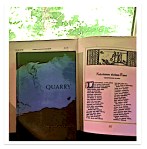
I was uniquely inspired reading the novel Quarry by M. A. Fuller. Not only did its psychological character portraits pull deeply, but there were wonderful Finno-Ugric connections here — hers: having Finnish/Sami history and identity central to the plot; mine: being tied to Estonian culture, who are kinfolk to Finns. I was moved to read along with my copy of the ancient Finnish verses known as Kalevala (similar to the Estonian Kalevipoeg)! And all of her story unfolds, path by path, with its impact upon those in North America which made it personally even more relevant. It is a magnificent book, as you can read below and on reviews by Kirkus and others online.
Here is my brief review as it appeared on Amazon on July 15, 2017.
QUARRY, by M.A. Fuller in front of Finnish Kalevala runic verses (in Estonian translation)
QUARRY: Mystical yet Deeply Grounded — Beautiful and Brilliant
QUARRY is is a truly captivating novel by Meredith Ann Fuller that has as its main character a girl/young woman who is psychologically haunted and creatively invested by immigrant legacies. Fuller draws vividly from the tumultuous history of North American Finns, their ancient cultural roots, the nightmarish lure of return of some to Karelia and subsequent betrayal by Stalin in the early twentieth century. All of this, with an added splash of Irish-American history, spills over into the life of Rose, who we meet as a traumatically-blinded child. With the help of a therapist, she recovers her sight, only to struggle mightily with what she must face internally.
Rose’s search for self and cohesion forces her to reach not only inward but back into inter-generational history. Fuller’s writing really shines here as she weaves in the spirits, spells, animals and magic that abound deep in Finnish, especially Sami, roots. As a reader familiar with the ancient Finnish epic, Kalevala, I found these connections authentic and mesmerizing. (The reviewer’s attached photo shows Fuller’s novel resting on an edition of Kalevala verses.)
As only a talented writer can do, Fuller leads us from Rose and her family’s journey to ones that hold broader truths, including the well of strength that can come from our roots even as we struggle with their impact. Furthermore, copious artistic illustrations throughout the book are so stunning they inspire like visual-poetic gems.
The author, illustrator (primarily Joan Anderson with others), and Mountain Water Press are to be commended for this sensitive, beautiful and brilliant book.
Sounds with the Young(Upton Street, NW, circa 2001) arose from my time at the Levine School in Music in Washington, DC., a large community music school that serves infants through adults.
“Splayed stairs, up this way or that, invite the affair of the day …”
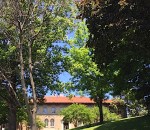
The poem opens with the building’s architectural beauty, something that likely deserves a work of its own. An elegant Spanish style revival, it was built in 1906-07 to house the Carnegie Institution of Washington’s Geophysical Laboratory. Specific requirements – high, dry, apart from magnetic disturbances – helped launch its site on a steep hill upon a rocky foundation.
The low, Mission-style tile roof became a “hat” for the “Lady on the Hill” in the poem. The idea of a welcoming lady must have subconsciously resonated from the idea of a universal Mother Goose as I thought of the children in my poem.
Brick and tile inlays above bay window arches
My colleagues brought music to life for young children in infinitely imaginative ways. One was Mara Bershad, who taught in the Washington area for decades before her too early demise. A musician, harpsichordist, and dancer she spun experiences for children from classical music, traditional songs, movement and artful collaboration that left us speechless with delight.
Dedicated to the Memory of Mara Bershad (1950-2010)
Sounds with the Young by Kaja Weeks was first published in District Lines: An Anthology of Original Local Work, V. 4 (Politics and Prose) in 2017.
***
Sounds with the Young (Upton Street, NW, circa 2001)
The music school sits like a lady on a hill,
with a red tile roof for a hat and
light stucco dress,
Spanish revival style, por favor. Carved limestone surrounds her entry.
Splayed stairs, up this way or that,
invite the affair of the day.
Singing four-year olds peal inside,
festive as nothing else you could imagine.
Today she has chosen Respighi and
Mara, curved-back like a cat,
pulls scarves along the floor and
suddenly twirls them high in the air.
Max stares and then lifts his arm
with his blue chiffon rising before Agnes,
light-footed as Mara, swipes it away.
Her giggles pounce – staccato as celesta
in The Pines of Rome.
Corinne, born in Gabon and raised on drums,
rolls her fingers and slaps her hands. Ka-ha-ha-booom, ka-boooooom! Reese and Chloé sound thunder from their hides, Ka-ha-ha-booom, ka-boooooom! But no tremors could disturb this building,
reborn from the Carnegie Geophysical Laboratory, 1907!
Solid as the rock she stands on. Roll on sounds!
Close by, Ming leads babies to sway.
Cries and gurgles in soft laps,
lullaby waltzes hummed and sung — Buy some Coulter’s candy. Next door a glossy petite gamelan jingles
and Indonesian shadow puppets dance while
Monica’s kids cluster in the hallway –
they can’t wait to sing like rain, jump puddles,
freeze mid-air to her piano sounds
that seem to spin them and stop them
like magical notes –
Zeke, Liam and resting-tone Lee.
Upstairs the serious folks have begun
to practice and play.
The old Russian pianist with a black pipe
demands perfection from her charges,
and Charles’ deep baritone voice
falls from windows and floats down
the wide green lawn toward Rock Creek.
At noon Sally, reciting summer camp to-do,
and Vera and I walk the shaded path
to Howard Law School cafeteria
where round tables with bud vases,
warm southern cooking and cool lemonade await.
The ceiling is high, murmurs alive.
We release our sighs into them,
trade quips and tales and sometimes
laugh so hard our bellies hurt –
before we head back for more blooming music
with the lady on the hill.
















 lived during the Cold War, and how anchovy (or, preferably, marinated sprat) open-faced sandwiches came to carry unique significance . . .






 Lyric Overtones