
Old Tunes on Spruce

Old Tunes on Spruce is from the collection Mouth Quill—Poems with Ancestral Roots. The video version includes my reading of it. A PDF of the text is available below.

Estonian Terms: Kannel – a zither, first played by the God of Music and Poetry; Kukukuu and pillilil – bird chatter in Estonian runic song verses

Some Reflections about Old Tunes on Spruce

The “lap harp made of spruce” in this poem refers to a kannel. This is a beloved instrument, embedded in Estonian mythology, and is the instrument played by Vanemuine, the God of Music. Soundboards of this instrument have often been made of spruce.  

I describe plucked tones clustering and rising. From the perspective of acoustics, when a string is plucked freely and reverberates it plays not only the fundamental tone, but also overtones are created, and they mingle and rise into the air. These clusters are sometimes harmonious and sometimes discordant—here, they symbolize the disparate experiences that came to me from the archaic songs: the beauty (beautiful melodies and sounds, scales, rhythms) but then, later, the realization of historical horrors (like the cattle trains that many, including in my own family, were piled and that led to Siberian suffering or death.)
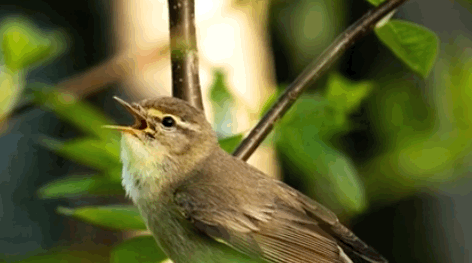
Runic songs are filled with the onomatopoeia of bird sounds

Later, I came to realize that the songs and sounds are not just my own, but an ancestral soundscape. The bird chatter Kukukuu, pillilill, vaak vaak vaa comes from a runic song Lind Lohutab (The Bird’s Consoling) and Iki Iki Mina Vaene. I have enjoyed singing this song with its many verses and variations, depending on the originating parish and singer.

As a writer, where to begin in trying to understand an original source song like this? Being fluent in Estonian, many words were familiar to me, but many were not, and not to my contemporaries either. Searching for the meaning of the word Iki, I wrote to the Estonian Language Institute, which also led me to dictionaries that contain dialects and archaic language. They explained that Iki here is in a dialect and means “to cry.”
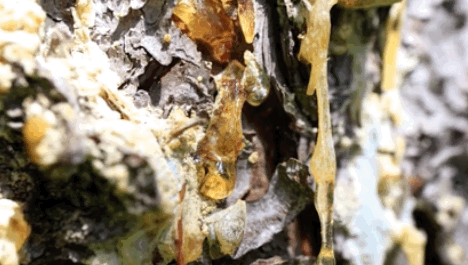
Sap forming from a tree

My poem ends with sap forming, a process that occurs when wood is injured, bringing to mind historical injuries, the wounds of our people. Here, sap is symbolic as a vessel containing both pain and beauty .

Poetry book coming!

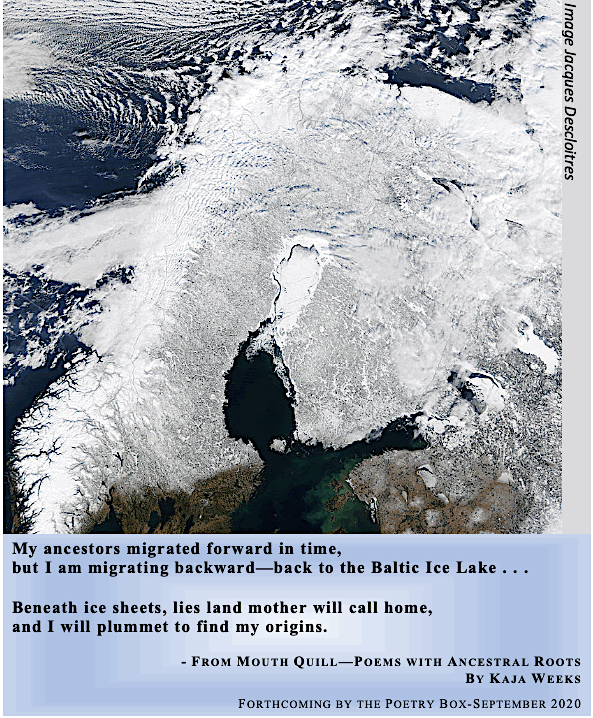
Baltic Ice Lake with caption

My chapbook of poetry is being published by The Poetry Box and is slated for release in September 2020! The lines below the photo are from the first poem, Ancestral Journey—Beneath Ice Sheets, which begins an imaginary exploration leading to the shores of Estonia. This poem is part of a trilogy, three poems that form the start, middle and end of the collection; the other two being Ancestral Journey—The Milky Way and Ancestral Journey—Helix.

I chose the satellite photo above to share this announcement as it so beautifully illustrates, by way of a (modern) snow line, the approximate glacier lines from 10,000 years ago! You can see Norway, Sweden, Finland, Estonia and even the small island of Saaremaa in this aerial image. Long ago, glacial ice covered all. When the melting began, I imagine the long journey of our Finnic ancestors, leaving the Urals:

Some will be left in river-bends,
some follow the reindeer north.

Some will look heavenward at traces of bird-flight,
some walk a milky star-path westward.

The term Mouth Quill (collection title and title of an individual poem) is found in runo verse (regilaul)—the word translates to suudesulg and refers to “a singer’s magical tool.” Some of the 21 poems are inspired by themes found in ancient runo verses (with the original runo verses listed in Notes), others by Estonian music, language and historic events. My writing weaves those world views into a life born and lived in America, with deep ancestral roots.

Poet Deirdre Callanan describes Mouth Quill—Poems with Ancestral Roots as “a dark crystal studded with light.”

First Home

First Home by Kaja Weeks is an essay published by The Sandy River Review (University of Maine, Farmington) on its website in October 2018.

The piece reflects not only aspects of my own first home, but also of my childhood friend’s home “around the corner,” and each of my parents’ first homes in Estonia (from which they fled during its occupation in World War II)—including my mother’s home located near the historic childhood home of renowned Estonian poet, Lydia Koidula. Koidula was the author of the poignant poem, Meil Aiaäärne Tänavas—The Road Bordering our Yard, which is referenced in the essay.

Click here to read a PDF of the essay First Home_Web

Cold Spin

Cold Spin by Kaja Weeks is a poem first published by The Sandy River Review online site in October 2018. The Sandy River Review is a literary journal of The University of Maine, Farmington.

Cold Spin recalls events that took place on a winter pond, separated from the banks of the Hackensack River by a thin meadowlands ridge. The time period was the early 1960s.

Click here to read the full poem online Cold Spin_Kaja Weeks_The Sandy River Review