
Old Tunes on Spruce

Old Tunes on Spruce is from the collection Mouth Quill—Poems with Ancestral Roots. The video version includes my reading of it. A PDF of the text is available below.

Estonian Terms: Kannel – a zither, first played by the God of Music and Poetry; Kukukuu and pillilil – bird chatter in Estonian runic song verses

Some Reflections about Old Tunes on Spruce

The “lap harp made of spruce” in this poem refers to a kannel. This is a beloved instrument, embedded in Estonian mythology, and is the instrument played by Vanemuine, the God of Music. Soundboards of this instrument have often been made of spruce.  

I describe plucked tones clustering and rising. From the perspective of acoustics, when a string is plucked freely and reverberates it plays not only the fundamental tone, but also overtones are created, and they mingle and rise into the air. These clusters are sometimes harmonious and sometimes discordant—here, they symbolize the disparate experiences that came to me from the archaic songs: the beauty (beautiful melodies and sounds, scales, rhythms) but then, later, the realization of historical horrors (like the cattle trains that many, including in my own family, were piled and that led to Siberian suffering or death.)
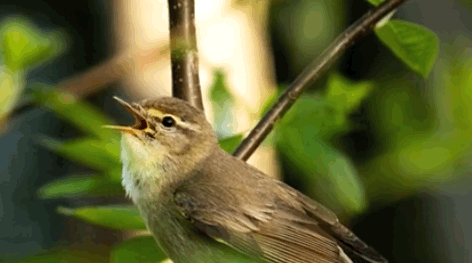
Runic songs are filled with the onomatopoeia of bird sounds

Later, I came to realize that the songs and sounds are not just my own, but an ancestral soundscape. The bird chatter Kukukuu, pillilill, vaak vaak vaa comes from a runic song Lind Lohutab (The Bird’s Consoling) and Iki Iki Mina Vaene. I have enjoyed singing this song with its many verses and variations, depending on the originating parish and singer.

As a writer, where to begin in trying to understand an original source song like this? Being fluent in Estonian, many words were familiar to me, but many were not, and not to my contemporaries either. Searching for the meaning of the word Iki, I wrote to the Estonian Language Institute, which also led me to dictionaries that contain dialects and archaic language. They explained that Iki here is in a dialect and means “to cry.”
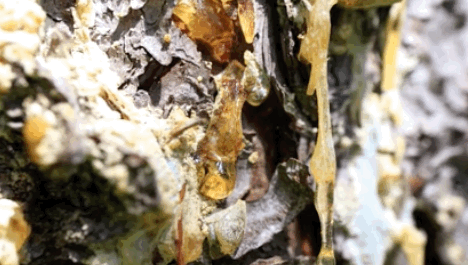
Sap forming from a tree

My poem ends with sap forming, a process that occurs when wood is injured, bringing to mind historical injuries, the wounds of our people. Here, sap is symbolic as a vessel containing both pain and beauty .
A Girl’s Singing Nirvana, My Mother’s Voice

A Girl’s Singing Nirvana, My Mother’s Voice is a lyrical essay with themes of autism in the young and stroke in the elderly. It tells a story of how each was able to use singing when wordlessness compounded their lives and reveals my journey with them.

A Girl’s Singing Nirvana, My Mother’s Voice by Kaja Weeks was first published by The Potomac Review, A Literary Arts Quarterly in 2015. I am very pleased and proud that the journal nominated my essay for a Pushcart Prize.

A Girl’s Singing Nirvana, My Mother’s Voice_Excerpt

A Girl’s Singing Nirvana, My Mother’s Voice copyright © 2015 by Kaja Weeks

The Silver Swan and Her Stroke: First Songs as Last Songs

My essay, The Silver Swan and Her Stroke: First Songs as Last Songs, is rooted in the profound effects of singing as entwined with mysteries of communication and love.

The poetic verse alluded to here, The Silver Swan, was first published in 1612 in the madrigal by Orlando Gibbons and illustrates the legend of “the swan song” – that silver swans sing only once, before their death. You can hear a beautiful performance of The Silver Swan round by British a cappella vocal ensemble, The King Singers.

The silver swan, who living had no note,
when death approached unlocked her silent throat;
Leaning her breast against the reedy shore,
thus sung her first and last, and sung no more.
Farewell, all joys; O Death, come close mine eyes;
More geese than swans now live, more fools than wise.

I am so pleased that this essay was published by Ars Medica: A Journal of Medicine, The Arts, and Humanities, Winter 2017. Ars Medica is the only medical literary journal in Canada, and one of a handful of such journals in the world. Click here to read the full piece at Ars Medica or The Silver Swan and Her Stroke_Kaja Weeks_Ars Medica_2017 to read in PDF format.


ABSTRACT

The Silver Swan and Her Stroke: First Songs as Last Songs

By Kaja Weeks

This is a view of a massive stroke followed by rare communications through singing and vocalization between an elegant lady born by the Baltic Sea almost 100 years ago and her daughter (the author). A reflective true account with story-like narration, it conveys the intersection of a musically rhythmic but “pitch deaf” mother and classically-trained singer daughter at their final crossroads. The stunning scene of hearing her mother, unable to speak, but singing “with full power and nuance, like a glorious Wagnerian soprano,” has the author first considering the extraordinary plasticity of the brain, and then, as a daughter, the poignant meaning of her mother’s sounds, who like the “Silver Swan,” sung her first and last, and sung no more.”


 The Silver Swan and Her Stroke: First Songs as Last Songs copyright © 2016 by Kaja Weeks

Whisper, Weep or Shimmer

What makes a sound unique – her voice recognizably different than mine, a violin from a harp, leaf shudder from wind – is carried in vibrations and their overtones. The complexity of harmonics, their patterns, intensity, onset and decline bring beauty, mystery or clanging noises that make up our soundscapes, literally and figuratively – in thought and word.

I have always been captivated by these configurations. Whether with my singing voice, with vowels that whisper, weep or shimmer or with words that infer thoughts of all that is unsaid – this is the play on waves and the spaces in between.