Old Tunes on Spruce

Old Tunes on Spruce is from the collection Mouth Quill—Poems with Ancestral Roots. The video version includes my reading of it. A PDF of the text is available below.

Estonian Terms: Kannel – a zither, first played by the God of Music and Poetry; Kukukuu and pillilil – bird chatter in Estonian runic song verses

Some Reflections about Old Tunes on Spruce

The “lap harp made of spruce” in this poem refers to a kannel. This is a beloved instrument, embedded in Estonian mythology, and is the instrument played by Vanemuine, the God of Music. Soundboards of this instrument have often been made of spruce.  

I describe plucked tones clustering and rising. From the perspective of acoustics, when a string is plucked freely and reverberates it plays not only the fundamental tone, but also overtones are created, and they mingle and rise into the air. These clusters are sometimes harmonious and sometimes discordant—here, they symbolize the disparate experiences that came to me from the archaic songs: the beauty (beautiful melodies and sounds, scales, rhythms) but then, later, the realization of historical horrors (like the cattle trains that many, including in my own family, were piled and that led to Siberian suffering or death.)
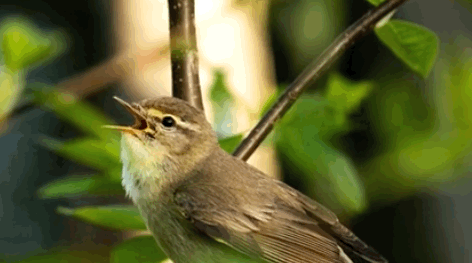
Runic songs are filled with the onomatopoeia of bird sounds

Later, I came to realize that the songs and sounds are not just my own, but an ancestral soundscape. The bird chatter Kukukuu, pillilill, vaak vaak vaa comes from a runic song Lind Lohutab (The Bird’s Consoling) and Iki Iki Mina Vaene. I have enjoyed singing this song with its many verses and variations, depending on the originating parish and singer.

As a writer, where to begin in trying to understand an original source song like this? Being fluent in Estonian, many words were familiar to me, but many were not, and not to my contemporaries either. Searching for the meaning of the word Iki, I wrote to the Estonian Language Institute, which also led me to dictionaries that contain dialects and archaic language. They explained that Iki here is in a dialect and means “to cry.”
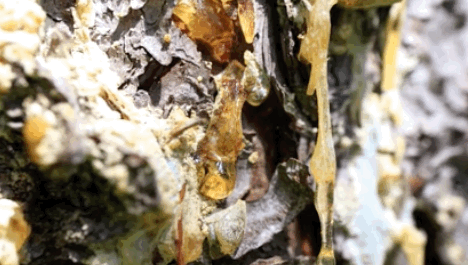
Sap forming from a tree

My poem ends with sap forming, a process that occurs when wood is injured, bringing to mind historical injuries, the wounds of our people. Here, sap is symbolic as a vessel containing both pain and beauty .

Poems from Mouth Quill sound as Choral Music

“Midsummer Birches,” a poem from my collection Mouth Quill—Poems with Ancestral Roots went live on June 24, 2021 as a choral pieces composed by Brigitte Doss-Johnson and sung by the virtual choir, Laulusild. A traditional old Estonian tune and words were woven with newly composed music set to my poetry. One piece is a celebration of Estonian Jaaniöö (Midsummer’s Eve) and Jaanipäev (Midsummer’s Day).

The English language poem begins by invoking Estonian traditions, referencing age-old verses and songs about this most important holiday: Jaaniöö birch leaves bitter-sweeten the air. A young man’s beloved rides his silk-tufted horse. Kaasike, kaasike, the refrain sounds. Trot with pride, mane bedecked with bangles.

The second poem and song is “The Rise,” which includes a recollection of my mother’s lullaby, an old Estonian song (Uni Tule), which I recall hearing as a very young child in America and realized later would have been sung by my grandmother in Estonia, who I never met. This motif is woven into newly composed music of the poem text . . . sleep mists its way from coastal stones crosses a thousand miles, fall upon my eye.

Singers include individuals from North America, Japan, the Basque region of northern Spain, Malaysia, and Estonians from the U.S., Canada, and Australia.

You can view the videos here:

Poetry book coming!

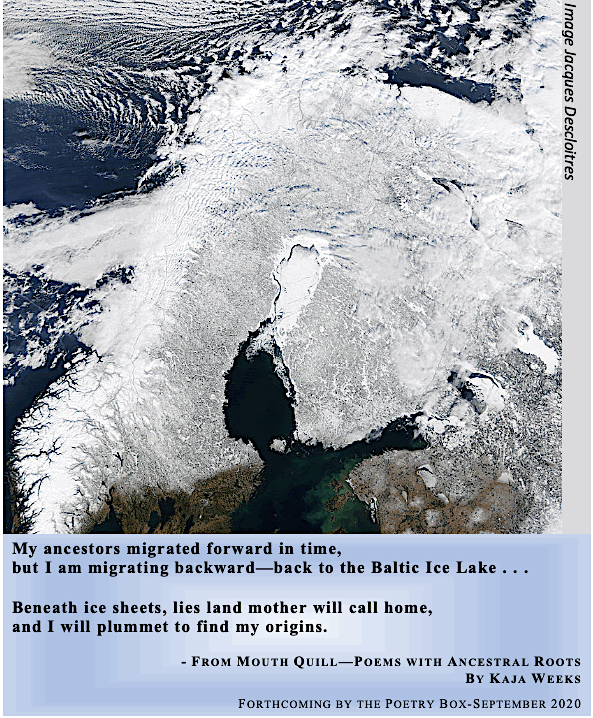
Baltic Ice Lake with caption

My chapbook of poetry is being published by The Poetry Box and is slated for release in September 2020! The lines below the photo are from the first poem, Ancestral Journey—Beneath Ice Sheets, which begins an imaginary exploration leading to the shores of Estonia. This poem is part of a trilogy, three poems that form the start, middle and end of the collection; the other two being Ancestral Journey—The Milky Way and Ancestral Journey—Helix.

I chose the satellite photo above to share this announcement as it so beautifully illustrates, by way of a (modern) snow line, the approximate glacier lines from 10,000 years ago! You can see Norway, Sweden, Finland, Estonia and even the small island of Saaremaa in this aerial image. Long ago, glacial ice covered all. When the melting began, I imagine the long journey of our Finnic ancestors, leaving the Urals:

Some will be left in river-bends,
some follow the reindeer north.

Some will look heavenward at traces of bird-flight,
some walk a milky star-path westward.

The term Mouth Quill (collection title and title of an individual poem) is found in runo verse (regilaul)—the word translates to suudesulg and refers to “a singer’s magical tool.” Some of the 21 poems are inspired by themes found in ancient runo verses (with the original runo verses listed in Notes), others by Estonian music, language and historic events. My writing weaves those world views into a life born and lived in America, with deep ancestral roots.

Poet Deirdre Callanan describes Mouth Quill—Poems with Ancestral Roots as “a dark crystal studded with light.”

Voices (Song Festival, Tallinn, Estonia)


Estonian World Kaja Weeks Voices Poem

A version of the poem “Voices” was first published by the online journal Estonian World.

Kaja Weeks: Estonian singing voices in a poem


Voices (Song Festival, Tallinn, Estonia)

Song-Mother’s voices,
sounds of ancestors once slipped from tongue to air—
ribbon-like, still unfurling.

On the edge of the sea
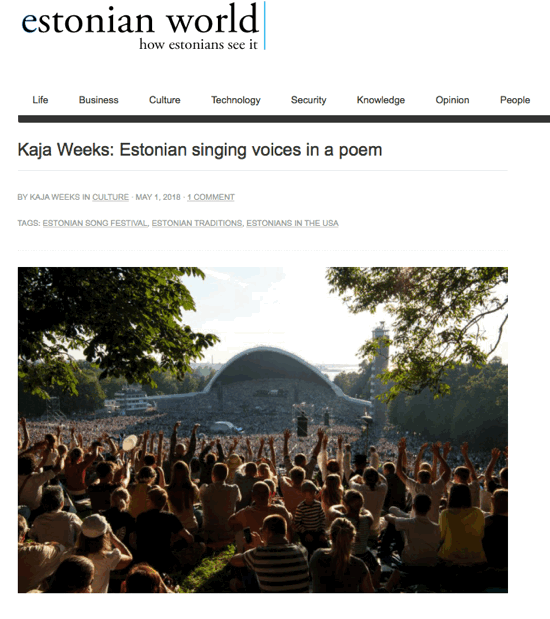
a silver shell holds thousands, singers who face
thousands more on a grassy gentle rise. All inhale.

Though the hour nears midnight
sun skims waters of the Baltic Sea,
flames in the tower-torch leap high.

The singing will not stop,
Lee—  lee— lo, the sounds form Leelo!
Each ancient syllable earned with sweat and love.

A conductor, peering from within a laurel wreath
clasps his chest, lowers his head,
bows to the choir who has honored song.

The watchers become the singers,
the standing levitate,
the air is alive.

Swirling round, melodies rustle, loosen hair,
saying: we are a living sound—sing us speak us hear us.
Song-Mother’s voices—Hääli imedänne!


* Hääli imedänne – Means “magical voices” in old Estonian
* Leelo – The old Estonian word meaning “song,” and the title of an actual song


Author’s Note: Voices is a poem from a chapbook manuscript (in progress) in which writings reflect both the trauma and beauty of Estonian culture and history as it rooted in my personal journey and identity.


Songs from my ancestral heritage have been a central part of my life. As a young child I was mesmerized by very old runic songs, called regilaulud—including shepherd’s calls (helletused). These came to me by way of the songstress Ellen Parve Valdsaar, an Estonian refugee whose magical interpretations left a lasting impression upon me. I also heard and sang much choral music, mostly in the a cappella tradition that allows voices to meld within wonderful, enlivening resonance. The poem, Voices, celebrates the height of such a continued tradition, the Estonian Song Festival, first begun in 1869. It is now held in Tallinn every five years and is designated a UNESCO “Masterpiece of the Oral and Intangible Heritage of Humanity.” Click here to hear a refrain from the song, “Leelo” (the old word for “song”) as sung at the 2014 Estonian Song Festival in Tallinn. (In “Leelo” composed by Mart Saar with text from traditional folkverse, the singers plead, “What are these reins, these ropes that bind us?” The antidote, they answer, is “Song! Song! Song!”)

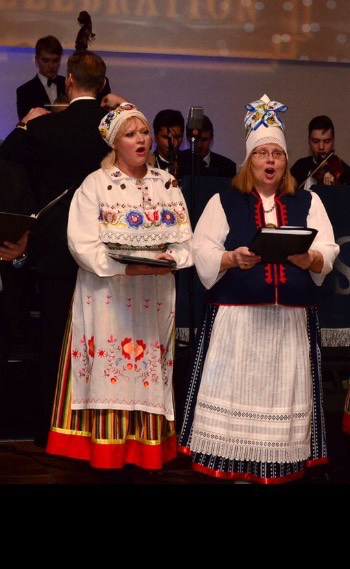
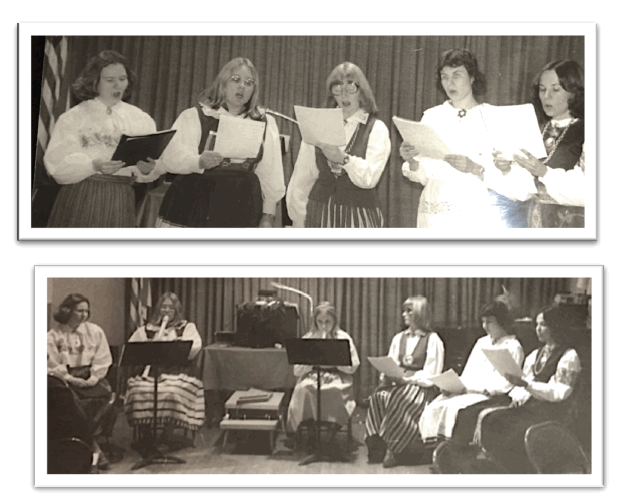
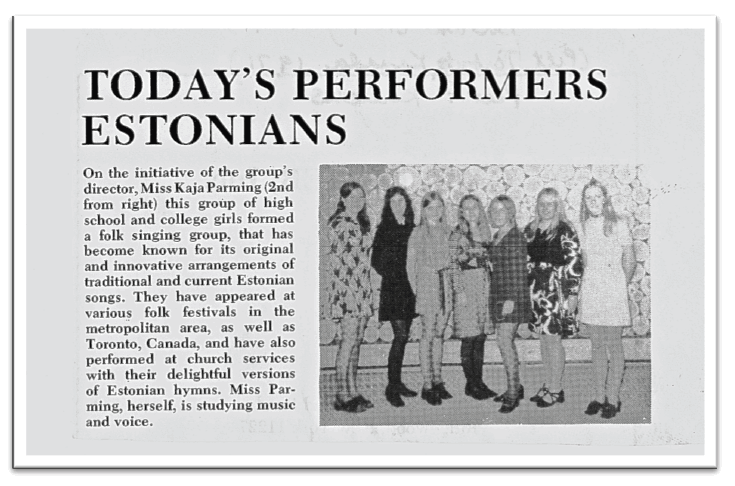
Even as the child of Estonian refugees to America, I understood the transcendent qualities of this music rooted in antiquity. In the 1970’s, as a college music student, I created a small vocal ensemble named Kannel (Zither) which performed mostly traditional Estonian music. Today, I sing with the Baltimore-Washington Estonian Singers (BWES), including in our performance for the capital area’s 100th Anniversary of the Republic of Estonia.

Kaja ja Iira EV100

Ira Reiman and Kaja Weeks in traditional Estonian folk costumes, singing as members of BWES at Washington DC- Celebration of 100th Year of Republic of Estonia. February 2018

Kannel Kaja Parming Lektor 1977 NY
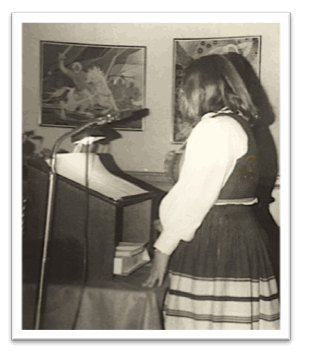
Kaja Parming delivering lecture about old Estonian folk music, New York, 1977.

Kannel 1977 NY
Ensemble Kannel performing in an evening of Lecture and Old Estonian Folk Songs. (Pictured in lower photo, left to right) Ursula Brady; Kaja Parming (Founder/Director); Talvi Laev; Tiia Papp; Angela Dupin; Kersti Tannberg. New York, 1977.

Kannel Toronto 1971

Kannel in Toronto, 1971 (Pictured from Left to Right) Tina Karm; Angela Dupin; Anneliis Elmend; Ursula Brady; Kaie Põhi; Kaja Parming (Founder/Director); Anne Pleer.