The Dolomite Heel Print

I’m honored to have had excerpts from The Dolomite Heel Print read by Claudia Green in Seattle at the poetry reading evening of Cirque—A Literary Journal for the North Pacific Rim.

Claudia Green reading The Dolomite Heel Print from Mouth Quill—Poems with Ancestral Roots by Kaja Weeks. At Cirque—A Literary Journal of the North Pacific Rim readings August 12, 2023

The Dolomite Heel Print is from the collection Mouth Quill—Poems with Ancestral Roots (Poetry Box, Portland 2020). Its seven sections focus on the island of Saaremaa, Estonia—its natural beauty, horrifying events of World War Two, and their intersection with my life as a young person during the Cold War and much later, the mystery revealed during a visit to the island’s Kuressaare Castle.

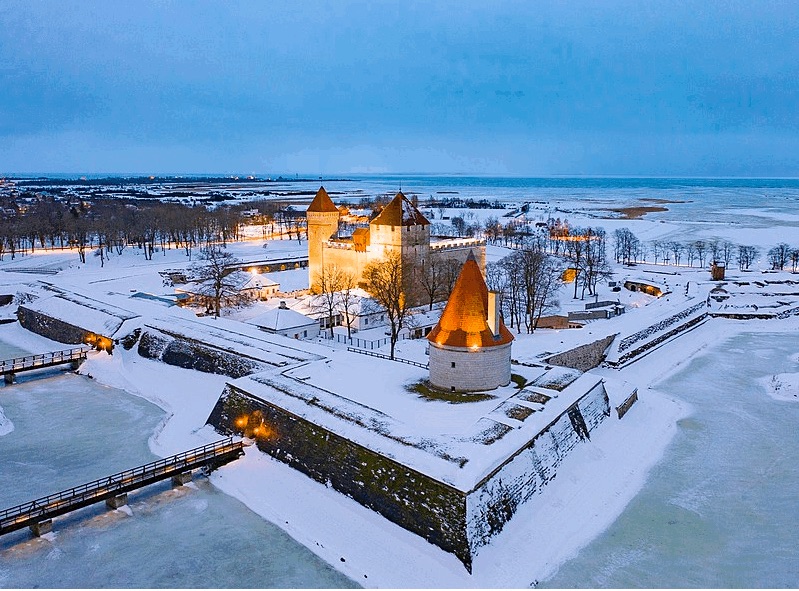
Below is a view of Kuressaare Castle, seen with its towers, bastions and the sea behind it (Stefan Hiienurm, Wikipedia, Common License.)
At the center of The Dolomite Heel Print poem is reference to an extraordinary song, Öö Pime (Dark Night) that came to us, children of Estonian refugees, nearly secretly during the Cold War. It was smuggled back to the west by a young relative of some homeland Estonians at a time when those in Estonia, still occupied by Communist Russia, could have suffered greatly had they been exposed. We sang the song amongst ourselves with great reverence, often with teary eyes as it spoke of departure from the ravaged homeland and vows to return one day.

Among those singing Öö Pime was Ensemble Kannel, a singing youth group of traditional Estonian music (Ursula Brady, Angela Dupin, Anneliis Elmend, Tina Karm, Tiiu Messner, Kaja Parming [Founder/Director], Anne Pleer, Kaie Põhi.) . According to newspaper accounts, one of our first public performances of the song was in 1970, but there is an even more historic recording from 1975. It is Ensemble Kannel singing at an important formal event in New York City, a commemoration of Estonian Independence. These were somber yet steadfast annual events, as Estonia was still occupied and regaining of freedom seemed like a dream (which was achieved in 1991). Toward the end of this recording, the audience can be heard spontaneously joining in, showing the widespread impact of the song by this point.

One historic reference in the song was to Estonian martyrs spilling blood round dolomite heel prints (lubjavildi kand), something we could not possibly have fully comprehended the meaning of as teenagers growing up in North America. That mystery was revealed to me decades later when I visited a free Estonia and met the dolomite craftsman of Kuressaare Castle. All these events (and research) eventually coalesced into the poem, The Dolomite Heel Print.

Author Deirdre Callanan, in her praise for poem, writes “Rich with birds and melody, these pages sing, but her incredible “The Dolomite Heel Print” makes sure we understand not all songs are merry. Mouth Quill, a dark crystal studded with light, amazes.

And author Hala Alyan says, “The Dolomite Heel Print, in particular, is a breathtaking exploration of history and life and identity … a stunning piece! “

Celebrating Estonian Mother Language Day

I felt very grateful to have been invited to share poetry from my collection Mouth Quill—Poems with Ancestral Roots—at VEMU, Museum of Estonians Abroad celebration of Estonian Mother Language Day (Emakeelepäev).

This day is a national holiday in Estonia, and a beautiful way to preserve and cherish the Estonian language. 

The virtual event included wonderful presenters. Janika Oras, Senior Folklore Scholar of The Estonian Literary Museum gave a fascinating overview of regilaulud, Estonia’s ancient oral song and verse tradition, and talked about how their influence—especially maternal qualities and the presence of multiple realities—permeated poetry in the Mouth Quill collection.

Kaja Telmet and Inga Eichenbaum, of Toronto, each recited a poem from the collection and Kaja Telmet talked about her emotional connection and understanding of the collection from the perspective of one whose family, like mine, were World War II refugees from Estonia.

Triinu Villukas and Madli Oras, two young Estonians and singers currently living in Vienna, Austria, led everyone in regilaulu singing, including the song which inspired content in my poem, Mouth Quill. Piret Noorhani, VEMU’s chief archivist put together a wonderful, rich program and moderated throughout.

You can read an English translation of my remarks here.

Poems from Mouth Quill sound as Choral Music

“Midsummer Birches,” a poem from my collection Mouth Quill—Poems with Ancestral Roots went live on June 24, 2021 as a choral pieces composed by Brigitte Doss-Johnson and sung by the virtual choir, Laulusild. A traditional old Estonian tune and words were woven with newly composed music set to my poetry. One piece is a celebration of Estonian Jaaniöö (Midsummer’s Eve) and Jaanipäev (Midsummer’s Day).

The English language poem begins by invoking Estonian traditions, referencing age-old verses and songs about this most important holiday: Jaaniöö birch leaves bitter-sweeten the air. A young man’s beloved rides his silk-tufted horse. Kaasike, kaasike, the refrain sounds. Trot with pride, mane bedecked with bangles.

The second poem and song is “The Rise,” which includes a recollection of my mother’s lullaby, an old Estonian song (Uni Tule), which I recall hearing as a very young child in America and realized later would have been sung by my grandmother in Estonia, who I never met. This motif is woven into newly composed music of the poem text . . . sleep mists its way from coastal stones crosses a thousand miles, fall upon my eye.

Singers include individuals from North America, Japan, the Basque region of northern Spain, Malaysia, and Estonians from the U.S., Canada, and Australia.

You can view the videos here:

Live Poetry Reading! Poems from Mouth Quill—Poems with Ancestral Roots

The Poetry Box, publisher of my book, will host its monthly live Zoom Poetry Reading on Saturday, October 10, 2020, 4 PM Pacific, 7 PM Eastern. I look forward to joining readings of two other poets, Christopher Bogart and Joan Colby (read by Wendy Colby).

Please join me to hear Ancestral Journey—Beneath Ice Sheets, Old Tunes on Spruce, Seabrook Farms (1949), The Songstress and more.

Join Zoom Meeting

https://zoom.us/j/93392882128?pwd=T2czaFFETEFGbVNidTRLZityRkdCUT09

Meeting ID: 933 9288 2128

Passcode: 954352

Mouth Quill—Poems with Ancestral Roots

The Poetry Box, a small independent publisher in Portland, Oregon, has done a beautiful job with my debut chapbook of poetry, ready now for pre-order here from my page on

CoverFront-MouthQuill
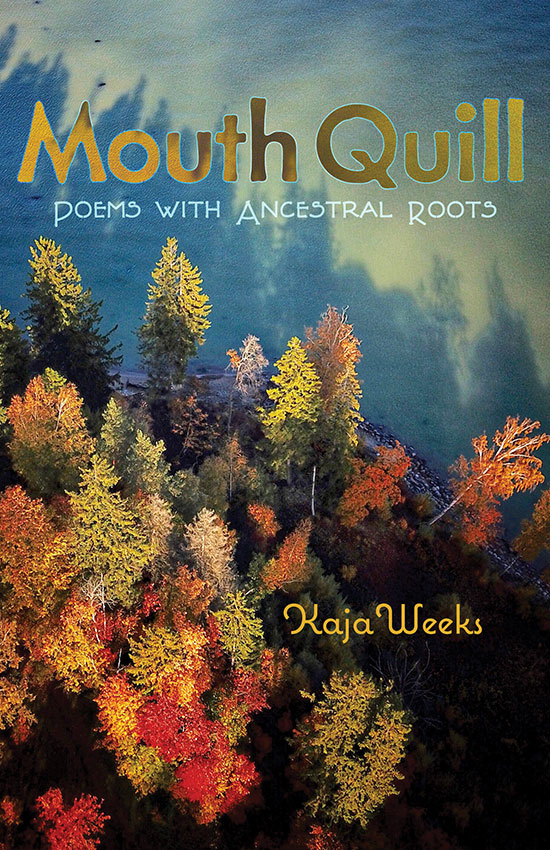
Mouth Quill: Poems with Ancestral Roots book cover, published by The Poetry Box

their website. Please visit to see a description and early reviews.

. . . a haunting intertwining of world history and family history.    ~ April Ossmann

The cover is a stunning photo of Estonian forest and sea by Michael Huang. I am so grateful for his gift to me for this collection.

The print edition is slated for September 30, 2020. At that point, you can also order the book from Amazon or from your favorite bookstores.

The term “mouth quill” (suude sulg) comes from ancient Estonian runic song and is seen as a singer’s magical tool. In a lovely verse known as The Village Tells Me, the singer says she has left home enchanting charms—her mouth quill and her tongue click—(keeleklõks). She bids her brothers to ride home with silver beaded horses to bring them to her so she can sing like birds.

When I was a young student, just starting college, I traveled to Finland to study and listen to rich Estonian field recordings of such music. In these last years, I feel so lucky to have been able to access notated music and even listen to oral history recordings on amazing online runic songs databases in Estonia. As I explored an arc of identity, many of these old songs inspired imagery and language in my poems, as did nature and historic events, both distant and more recent.