
Old Tunes on Spruce is from the collection Mouth Quill—Poems with Ancestral Roots. The video version includes my reading of it. A PDF of the text is available below.
Estonian Terms: Kannel – a zither, first played by the God of Music and Poetry; Kukukuu and pillilil – bird chatter in Estonian runic song verses
Some Reflections about Old Tunes on Spruce
The “lap harp made of spruce” in this poem refers to a kannel. This is a beloved instrument, embedded in Estonian mythology, and is the instrument played by Vanemuine, the God of Music. Soundboards of this instrument have often been made of spruce.
I describe plucked tones clustering and rising. From the perspective of acoustics, when a string is plucked freely and reverberates it plays not only the fundamental tone, but also overtones are created, and they mingle and rise into the air. These clusters are sometimes harmonious and sometimes discordant—here, they symbolize the disparate experiences that came to me from the archaic songs: the beauty (beautiful melodies and sounds, scales, rhythms) but then, later, the realization of historical horrors (like the cattle trains that many, including in my own family, were piled and that led to Siberian suffering or death.)
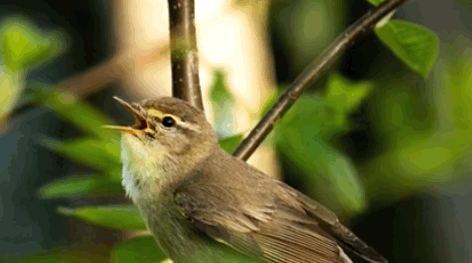
Later, I came to realize that the songs and sounds are not just my own, but an ancestral soundscape. The bird chatter Kukukuu, pillilill, vaak vaak vaa comes from a runic song Lind Lohutab (The Bird’s Consoling) and Iki Iki Mina Vaene. I have enjoyed singing this song with its many verses and variations, depending on the originating parish and singer.
As a writer, where to begin in trying to understand an original source song like this? Being fluent in Estonian, many words were familiar to me, but many were not, and not to my contemporaries either. Searching for the meaning of the word Iki, I wrote to the Estonian Language Institute, which also led me to dictionaries that contain dialects and archaic language. They explained that Iki here is in a dialect and means “to cry.”
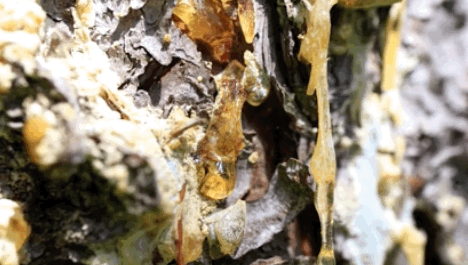
My poem ends with sap forming, a process that occurs when wood is injured, bringing to mind historical injuries, the wounds of our people. Here, sap is symbolic as a vessel containing both pain and beauty .
 Lyric Overtones