Old Tunes on Spruce is from the collection Mouth Quill—Poems with Ancestral Roots. The video version includes my reading of it. A PDF of the text is available below.
Estonian Terms: Kannel – a zither, first played by the God of Music and Poetry; Kukukuu and pillilil – bird chatter in Estonian runic song verses
SomeReflections about Old Tunes on Spruce
The “lap harp made of spruce” in this poem refers to a kannel. This is a beloved instrument, embedded in Estonian mythology, and is the instrument played by Vanemuine, the God of Music. Soundboards of this instrument have often been made of spruce.
I describe plucked tones clustering and rising. From the perspective of acoustics, when a string is plucked freely and reverberates it plays not only the fundamental tone, but also overtones are created, and they mingle and rise into the air. These clusters are sometimes harmonious and sometimes discordant—here, they symbolize the disparate experiences that came to me from the archaic songs: the beauty (beautiful melodies and sounds, scales, rhythms) but then, later, the realization of historical horrors (like the cattle trains that many, including in my own family, were piled and that led to Siberian suffering or death.)
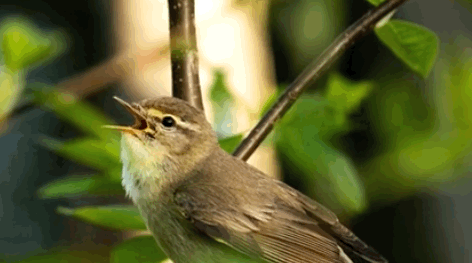
Runic songs are filled with the onomatopoeia of bird sounds
Later, I came to realize that the songs and sounds are not just my own, but an ancestral soundscape. The bird chatter Kukukuu, pillilill, vaak vaak vaa comes from a runic song Lind Lohutab (The Bird’s Consoling) and Iki Iki Mina Vaene. I have enjoyed singing this song with its many verses and variations, depending on the originating parish and singer.
As a writer, where to begin in trying to understand an original source song like this? Being fluent in Estonian, many words were familiar to me, but many were not, and not to my contemporaries either. Searching for the meaning of the word Iki, I wrote to the Estonian Language Institute, which also led me to dictionaries that contain dialects and archaic language. They explained that Iki here is in a dialect and means “to cry.”
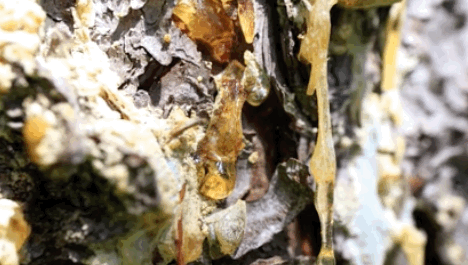
Sap forming from a tree
My poem ends with sap forming, a process that occurs when wood is injured, bringing to mind historical injuries, the wounds of our people. Here, sap is symbolic as a vessel containing both pain and beauty .
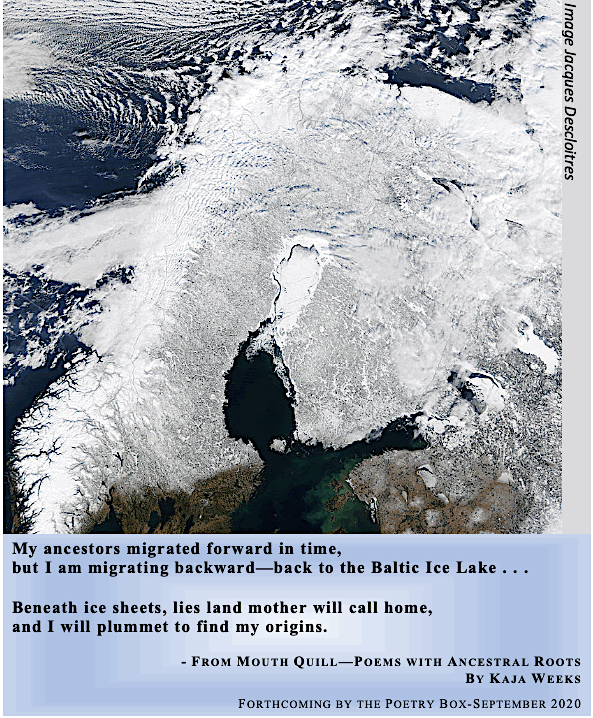
My chapbook of poetry is being published by The Poetry Box and is slated for release in September 2020! The lines below the photo are from the first poem, Ancestral Journey—Beneath Ice Sheets, which begins an imaginary exploration leading to the shores of Estonia. This poem is part of a trilogy, three poems that form the start, middle and end of the collection; the other two being Ancestral Journey—The Milky Way and Ancestral Journey—Helix.
I chose the satellite photo above to share this announcement as it so beautifully illustrates, by way of a (modern) snow line, the approximate glacier lines from 10,000 years ago! You can see Norway, Sweden, Finland, Estonia and even the small island of Saaremaa in this aerial image. Long ago, glacial ice covered all. When the melting began, I imagine the long journey of our Finnic ancestors, leaving the Urals:
Some will be left in river-bends, some follow the reindeer north.
Some will look heavenward at traces of bird-flight, some walk a milky star-path westward.
The term Mouth Quill (collection title and title of an individual poem) is found in runo verse (regilaul)—the word translates to suudesulg and refers to “a singer’s magical tool.” Some of the 21 poems are inspired by themes found in ancient runo verses (with the original runo verses listed in Notes), others by Estonian music, language and historic events. My writing weaves those world views into a life born and lived in America, with deep ancestral roots.
Poet Deirdre Callanan describes Mouth Quill—Poems with Ancestral Roots as “a dark crystal studded with light.”
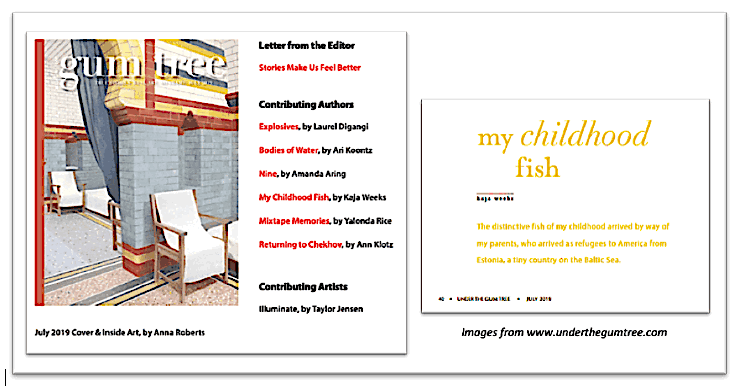
Published as “My Childhood Fish” in Under the Gum Tree . . . July 2019
Under the Gum Tree is a quarterly literary arts magazine that publishes creative nonfiction and visual art. I am so pleased that my writing found a home in their fine publication. You can order print or digital copies from their website.
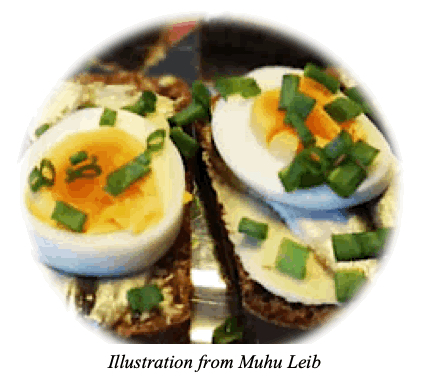
This is a personal essay with reminiscences from an Estonian-American childhood lived during the Cold War, and how anchovy (or, preferably, marinated sprat) open-faced sandwiches came to carry unique significance . . .
Symbols of ethnic pride and resolve, these little fish sandwiches were traditionally curated and ubiquitous especially after ceremonies remembering Estonian independence . . . in the rooms of the Estonian Civic Club on Manhattan’s East 34thStreet, elder-ladies unfailingly set tables with white tablecloths, flowers, percolated coffee—hot, dark and strong—and always platters of these little fish sandwiches.
And how a refugee-mother’s own longing for a childhood fish (the Räim, a kind of Baltic herring) eventually became a mirror for her daughter’s personal longing . . .
My mother’s perch was lovingly made, the just-warm, salted, golden fillets arranged on a plate with twisted slices of lemon and fresh parsley sprigs.
***
Special Thanks to the IOTA Conference Online Course (2017), taught by American essayist, Sarah Einstein, for inspiring and leavening my creativity, leading to publication of both “My Childhood Fish” as well as the essay, “First Home.”
When my mother was a young girl growing up during the late 1920s and early 1930s she lived in Eesti, a free land, dotted with islands, its northern coastline a curly ribbon on the Gulf of Finland. Western Estonia opens to the Baltic Sea. Her seaside hometown, Pärnu, on its own glittering inlet of the softest white sand beaches, murmurs with endless surf, coastal pinewoods-and- meadows. The harbor, a longtime merchant port, and famous restorative spas have always infused a cosmopolitan air, too. There is a saying, “If you let Pärnu, with its sun and sea breezes, into your system, your cloud of worries will waft away,” and certainly my mother’s forehead would always smooth out even as she sighed and spoke of her “good growing years” there.
There is a photo of my mother and her cousin, Helga, who visited from inland in the summers. They are both wearing stylish casual, fitted dresses, mother’s coiffure flapper-like wavy, a small white sailor hat perched on Helga’s head. They are sitting fountain-side at the famous Pärnu Mudbaths and Spa. It’s an elegant neo-classical building co-designed by the renowned architect Olav Siinmaa with whom Mother was soon to get her first job. She was sixteen, still innocent, unknowing of all the horrors that war, deadly occupations, fleeing and life’s turns would bring.
But this was around the time she acquired the silver brooch, which I now hold in my hand. The year is 2016, mother’s earthly life is past and I have so little, really, to connect to the person she once was. Though she raised me and lived well into her nineties, I felt as if I was continually seeking her core – so ephemeral. It’s as if her historic destiny endowed cloaks of spectacular resolve and stoic endurance (in a crisis she once declared, “I am the keeper of my own soul,” when I proposed help) and tactics worthy of an institution for preserving the dignity and culture of her lost world. But it snatched away the budding young girl who had once loved her life in a simple, seaside town in a free land; Even from inside, where we get to create and hold our woven selves, I sensed a lost space where it should be. I am haunted by and grieving of that loss for her, probably wishing to protect both of us from what followed, its inter-generational rubble. Sparsely told stories from her childhood and youth are well-guarded in my mind, enhanced over the years with scarce photos and then with world-wide-web image searches, scouring of maps, finally visiting myself and walking the ground she walked, breathing that highly oxygen-rich sea air – trying to re-create a world with a legacy that holds the pearls of mother.
Her brooch is not domed or smooth, but a special “Pärnu-style” flat cast with a jagged coastline shape and interior adorned by flower motifs – one for which the city was already a unique site of creation in the previous century. I only remember from her that it was a gift, possibly from her godmother for her “Kaubanduskooli” (Business Trade High School) graduation from which she landed the coveted city hall position with architect Siinmaa. It must have been a cherished item. Not that many years later, the autumn she fled, the second Soviet onslaught had breeched the border, while retreating Nazis blew up myriad buildings and bridges. Pärnu was burning, lit from above with pale columns of aerial bombings; flames raced along crowns of coastal trees. In the space where her high school had stood, ruins smoldered. Leaving her homeland forever, she carried that brooch with her few belongings. Decades later she quietly gave it to my then teenage daughter.
Now I hold this brooch that I’ve taken to the jeweler to be cleaned, polished, and the clasp repaired, secretly restoring it for my daughter’s approaching wedding. It was completely darkened when I brought it in, but when I retrieved it the jeweler was smiling with pride. He had worked hard to clean all the tiny crevices. “It’s silver,” he said with delight. Sitting on my bed, I turn the gleaming piece over in my hand. My mothers initials (as I have always known them) have always been visible in what I recognize as my father’s scratchy, invasive style, one that he enacted with all my things, as well – possessions possessed. But now I notice something that eluded my eye before, something revealed by removing the shades of time. Delicate lines form a year and shape letters. It takes me a moment to place them, and then I am flooded with sadness and joy: “SK” – my mother’s maiden monogram! Along this untarnished silver I rub my finger on such tiny lines, attach, and hold SK, born in a free land by the sea.

 lived during the Cold War, and how anchovy (or, preferably, marinated sprat) open-faced sandwiches came to carry unique significance . . .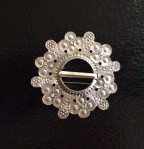
 Lyric Overtones