
Old Tunes on Spruce

Old Tunes on Spruce is from the collection Mouth Quill—Poems with Ancestral Roots. The video version includes my reading of it. A PDF of the text is available below.

Estonian Terms: Kannel – a zither, first played by the God of Music and Poetry; Kukukuu and pillilil – bird chatter in Estonian runic song verses

Some Reflections about Old Tunes on Spruce

The “lap harp made of spruce” in this poem refers to a kannel. This is a beloved instrument, embedded in Estonian mythology, and is the instrument played by Vanemuine, the God of Music. Soundboards of this instrument have often been made of spruce.  

I describe plucked tones clustering and rising. From the perspective of acoustics, when a string is plucked freely and reverberates it plays not only the fundamental tone, but also overtones are created, and they mingle and rise into the air. These clusters are sometimes harmonious and sometimes discordant—here, they symbolize the disparate experiences that came to me from the archaic songs: the beauty (beautiful melodies and sounds, scales, rhythms) but then, later, the realization of historical horrors (like the cattle trains that many, including in my own family, were piled and that led to Siberian suffering or death.)
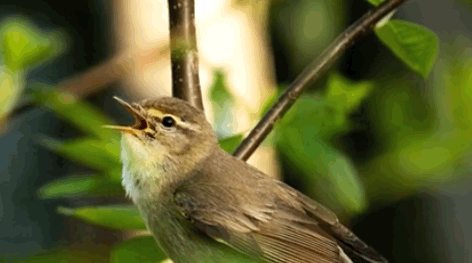
Runic songs are filled with the onomatopoeia of bird sounds

Later, I came to realize that the songs and sounds are not just my own, but an ancestral soundscape. The bird chatter Kukukuu, pillilill, vaak vaak vaa comes from a runic song Lind Lohutab (The Bird’s Consoling) and Iki Iki Mina Vaene. I have enjoyed singing this song with its many verses and variations, depending on the originating parish and singer.

As a writer, where to begin in trying to understand an original source song like this? Being fluent in Estonian, many words were familiar to me, but many were not, and not to my contemporaries either. Searching for the meaning of the word Iki, I wrote to the Estonian Language Institute, which also led me to dictionaries that contain dialects and archaic language. They explained that Iki here is in a dialect and means “to cry.”
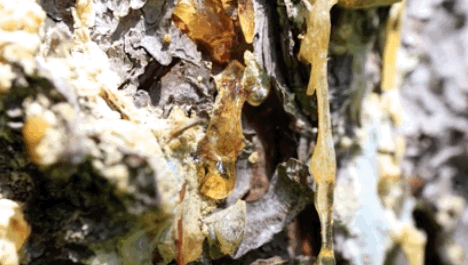
Sap forming from a tree

My poem ends with sap forming, a process that occurs when wood is injured, bringing to mind historical injuries, the wounds of our people. Here, sap is symbolic as a vessel containing both pain and beauty .
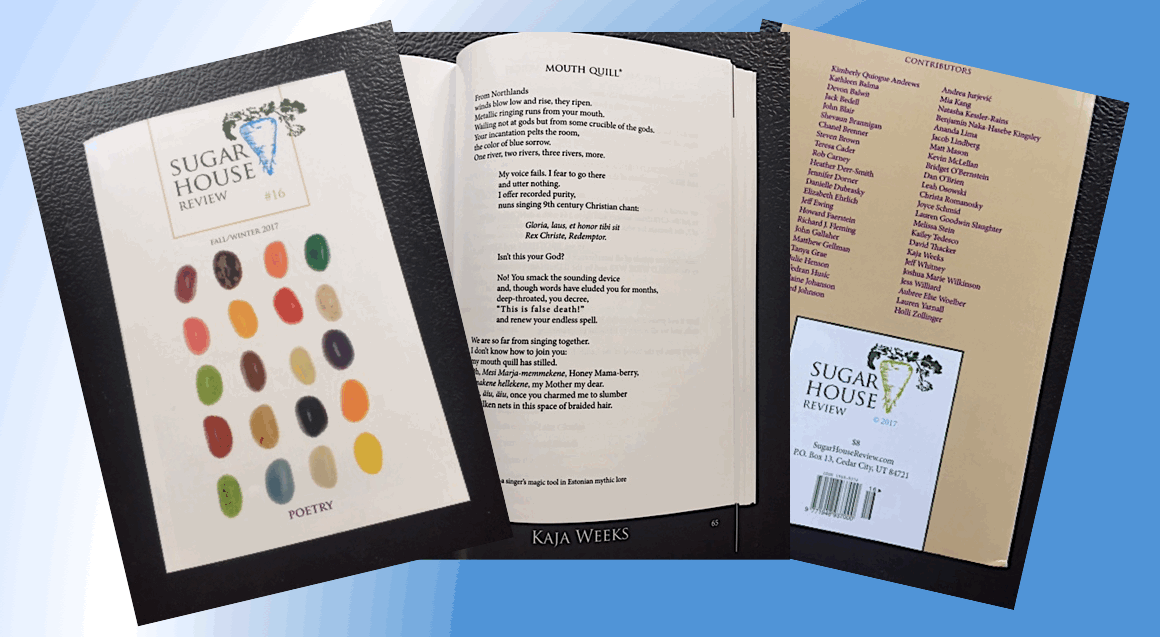
Mouth Quill

Sugar House Review_Mouth Quill
A version of the poem “Mouth Quill” by Kaja Weeks was first published in the literary journal Sugar House Review, Fall/Winter 2017.

Mouth Quill*

At home my stroke-assaulted mother
you startle and confound me.
On my childhood bed
we eye each other.

Metallic ringing runs from your mouth.
Wailing not at gods
but from some crucible of the gods.
From those Northlands
winds blow low and rise, they ripen.
Your incantation pelts the room,
the color of blue sorrow.
One river, two rivers, three rivers, more.

My voice fails. I fear to go there
and utter nothing.
I offer recorded purity,
nuns singing 9th century Christian chant:

Gloria, laus, et honor tibi sit
Rex Christe, Redemptor.

Isn’t this your God?
No! You smack the sounding device
and, though words have eluded you for months,
deep-throated, you decree,
“This is false death!”
and renew your endless spell.

We are so far from singing together.
I don’t know how to join you:
my mouth quill has stilled.
Oh, Mesi Marja-memmekene, Honey Mama-berry,
Emakene hellekene, my Mother my dear.
Äiu, äiu, äiu, once you charmed me to slumber
on silken nets in this space of braided hair.


* Mouth quill – “Suude sulg,” is a singer’s magic tool, and is found in Estonian mythic lore and runic verses


The poem Mouth Quill by Kaja Weeks was reviewed on New Pages as part of its coverage of The Sugar House Review issue in which it appeared. Mouth Quill was cited as succeeding in being “concentrated language striving to be music,” and with the description, “Carefully placed alliteration, assonance, and other literary devices create a fascinating and aurally pleasing poem.”


Author’s Note: Mouth Quill is a poem from a chapbook manuscript (in progress) in which writings reflect both the trauma and beauty of Estonian culture and history as it rooted in my personal journey and identity.

The Wedding of Salme

The Wedding of Salme*

By Kaja Weeks

* Adapted from Tähemõrsja (Starbride), an ancient Estonian runic song/verse
and composed in memory of my mother, Salme M.

On a field moist with morning fog,
by a craggy shepherd’s path it lay.
A little hen’s egg, left alone,
no nest, poor thing, just dew.

Walking there a widow spied it,
lifted it gently, clutched it closely
into her apron pocket she tucked
the tiny treasure, a chilly shell.

Then the egg she did warm,
three months, another and then a day.
The foundling was born, a child emerged,
a girl so sweet and full of grace.

Salme blossomed, into beauty
she grew. A maiden chaste who
many courted, wooed with gifts
and begged her to wed.

Not to the Sun with fifty horses,
Nor to the waxing-then-waning moon,
but to a celestial suitor, steady and bright,
son of the North Star, she did consent.

“Wed, Maid Salme, with Starry Youth,”
I did whisper, hidden in time.
“So airy and light and silver-voiced,
your daughter fine I can be.”

The tall wise oaks and dashing alders,
their trailing catkins, roots and branches,
all to your wedding who come, then
my uncles and aunties – my kin shall be.

So Salme, in silk, and Star, a-shimmering,
the Cross-Cane danced upon the green,
Thus betrothed, the chariot alit,
they ascended to dwell in the sky.

Now fearless and free, I may dance
across earth or foaming sea.
Mother, your shield casts from above,
so constant, so bright, ever on me.

Copyright © 2015 by Kaja Weeks

The Wedding of Salme was first published by Fickle Muses: Journal of Mythic Poetry and Fiction


About the Poem …

The Wedding of Salme is derived from one of the most ancient surviving Estonian myths, Starbride (Tähemõrsja) and recreated with my personal twist of longing by entering the imagined space –“I did whisper, hidden in time.” A characteristic of my writing often is that the past, even very distant past, fluidly interlaces the present or future.

There are many versions of this beautiful myth to be found in Estonian sources. While they all tell the same basic story, the verse expressions of the runic verses (regilaul) show rich regional variety and it was a thrill to research beyond my own basic knowledge when I began creating an interpretation in my own words. I loved knowing how ancient the origins were — over a thousand years or more — reciting the beautiful sounds aloud, and cherishing the early oral preservation that spoke of people’s hopes, wishes, and understanding of their world.

Estonian runic verses are highly stylized in meter and other literary qualities. Although it wasn’t possible to re-create all of that, I wanted to pay homage to some of the rhetorical characteristics, such as alliteration (the same sound at the beginning of words, e.g. “So Salme in silk and Star a-shimmering”); assonance (repeated vowel sounds, e.g. “moist with morning fog”); and parallelism (repeating ideas in a symmetrical way, e.g. “the tiny treasure, a chilly shell.”) all framed within a rhythmic, prosodic style.